The binding energy per molecule of NaCl (lattice parameter is 0.563 nm) is 7.95 eV. The repulsive term of the potential is of the form $\frac{K}{r^5}$, where K is a constant. The value of the Madelung constant is ________ (upto three decimal places) (Electron charge $e = -1.6 \times 10^{-19}$ C; $\epsilon_0 = 8.854 \times 10^{-12}$ $C^2N^{-1}m^{-2}$)
Madelung Constant Formula Explanation
The binding energy ($E_b$) per molecule for an ionic crystal is related to the Madelung constant ($M$) via the Born-Landé equation. This equation considers the electrostatic attraction and short-range repulsion between ions.
The formula for binding energy is:
$ E_b = \frac{M \alpha e^2}{4 \pi \epsilon_0 r_0} \left( 1 - \frac{1}{n} \right) $
Where:
- $M$ is the Madelung constant.
- $\alpha$ is the magnitude of the ionic charge (for NaCl, $\alpha=1$).
- $e$ is the magnitude of the elementary charge.
- $\epsilon_0$ is the permittivity of free space.
- $r_0$ is the shortest distance between adjacent ions (interionic distance).
- $n$ is the exponent in the repulsive potential term ($K/r^n$).
Madelung Constant Calculation Steps
Given Information:
- Binding energy per molecule, $E_b = 7.95$ eV.
- Lattice parameter, $a = 0.563$ nm. For NaCl structure, the interionic distance $r_0 = a/2$.
- Repulsive potential term is $K/r^5$, so the exponent $n = 5$.
- Elementary charge magnitude, $e = 1.6 \times 10^{-19}$ C.
- Permittivity of free space, $\epsilon_0 = 8.854 \times 10^{-12}$ $C^2N^{-1}m^{-2}$.
- Ionic charge magnitude for NaCl, $\alpha = 1$.
Step 1: Determine the interionic distance ($r_0$)
The interionic distance $r_0$ is half the lattice parameter $a$.
$r_0 = \frac{a}{2} = \frac{0.563 \text{ nm}}{2} = 0.2815 \text{ nm}$
Convert $r_0$ to meters:
$r_0 = 0.2815 \times 10^{-9} \text{ m}$
Step 2: Convert Binding Energy ($E_b$) to Joules
$ E_b = 7.95 \text{ eV} \times (1.6 \times 10^{-19} \text{ J/eV}) = 1.272 \times 10^{-18} \text{ J} $
Step 3: Rearrange the Born-Landé formula to solve for $M$
$ M = \frac{4 \pi \epsilon_0 r_0 E_b}{\alpha e^2 \left( 1 - \frac{1}{n} \right)} $
Step 4: Substitute the known values into the rearranged formula
$ M = \frac{4 \pi (8.854 \times 10^{-12} \text{ C}^2\text{N}^{-1}\text{m}^{-2}) (0.2815 \times 10^{-9} \text{ m}) (1.272 \times 10^{-18} \text{ J})}{(1) (1.6 \times 10^{-19} \text{ C})^2 \left( 1 - \frac{1}{5} \right)} $
Step 5: Perform the calculation
Calculate the numerator:
$ \text{Numerator} = 4\pi \times (8.854 \times 10^{-12}) \times (0.2815 \times 10^{-9}) \times (1.272 \times 10^{-18}) \approx 3.987 \times 10^{-38} $
Calculate the denominator:
$ \text{Denominator} = (1.6 \times 10^{-19})^2 \times (1 - 0.2) = (2.56 \times 10^{-38}) \times 0.8 = 2.048 \times 10^{-38} $
Compute $M$:
$ M = \frac{3.987 \times 10^{-38}}{2.048 \times 10^{-38}} \approx 1.947 $
The calculated value for the Madelung constant is approximately 1.947. The question states the correct value lies between 1.745 and 1.751.
Important Questions from Crystal Structure Bravais Lattices Unit Cell
- For a two-dimensional hexagonal lattice with lattice constant $ a $, the atomic density is
- Consider a crystal that has a basis of one atom. Its primitive vectors are $ \vec{a_1} = a\hat{i} $, $ \vec{a_2} = a\hat{j} $, $ \vec{a_3} = \frac{a}{2}(\hat{i} + \hat{j} + \hat{k}) $, where $ \hat{i}, \hat{j}, \hat{k} $ are the unit vectors in the $ x, y $ and $ z $ directions of the Cartesian coordinate system and $ a $ is a positive constant. Which one of the following is the correct option regarding the type of the Bravais lattice?
- A compound consists of three ions X, Y and Z. The Z ions are arranged in an FCC arrangement. The X ions occupy $\frac{1}{6}$ of the tetrahedral voids and the Y ions occupy $\frac{1}{3}$ of the octahedral voids. Which one of the following is the CORRECT chemical formula of the compound?
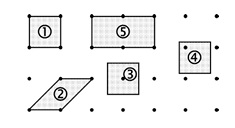
For the given unit cells of a two dimensional square lattice, which option lists all the primitive cells?
The number of distinct ways the primitive unit cell can be constructed for the two dimensional lattice as shown in the figure is ______.