The Annual Net Primary Productivity on land and ocean respectively are ________ and ________ billion tons.
115, 55
Net primary productivity (NPP) is the gross primary productivity minus the respiration losses of the producers; it is the biomass available to heterotrophs.
Step 1 — NCERT gives the annual NPP of the whole biosphere as about 170 billion tons (dry weight) of organic matter.
Step 2 — Of this, the oceans contribute only about 55 billion tons, even though they occupy about 70 percent of the surface, because light and nutrients limit ocean productivity.
Step 3 — Land therefore contributes 170 − 55 = 115 billion tons.
So the land value comes first (115) and the ocean value second (55). The pair 55, 115 reverses land and ocean, and the pairs containing 170 and 107 mix in the total for the whole biosphere.
115, 55 option is correct.
Similar Questions
Given below are two statements.
Statement I: There is less species biodiversity in tropical latitudes than in temperate region
Statement II: Tropical environments unlike temperate ones are less seasonal, relatively more constant and predictable.
In the light of the above statements, choose the correct answer from the options given below.
Which one of the following options represents the steps of decomposition in sequence?
The following graphs represent age pyramids of a population.
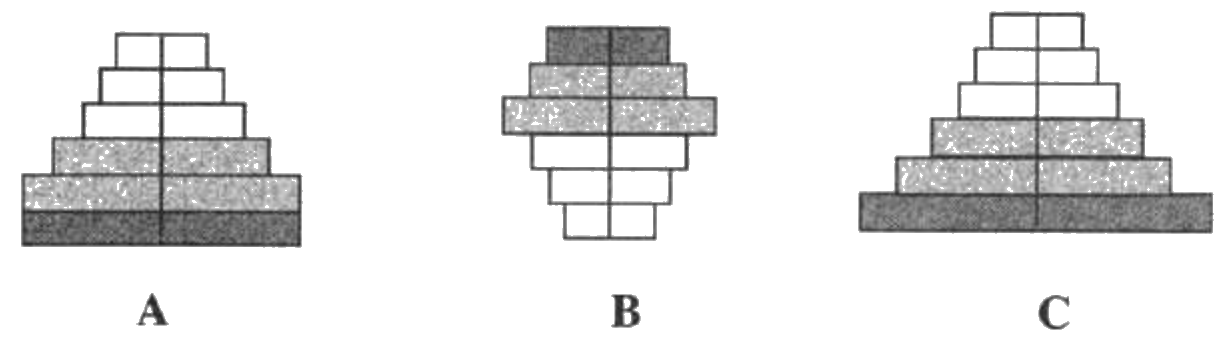
Identify the correct option representing the status of age pyramids labelled as A, B and C.
Which of the following is not correct with reference to exponential growth model?
Important Questions from Ecology
- Given below are two statements : one is labelled as Assertion A and the other is labelled as Reason R.
Assertion A : Abingdon tortoise in Galapagos islands became extinct within a decade after goats were introduced.
Reason R : Goats were more efficient at browsing than Abingdon tortoise.
In the light of the above statements, choose the most appropriate answer from the options given below : - Which of the following statements are correct ?
(a) Energy flow from producers to consumers is unidirectional
(b) Energy pyramid can never be inverted
(c) Transfer of energy follows the 1% law
Choose the correct answer from the options given below : - Arrange the following in descending order of number of species in the Amazonian rain forest.
(a) Plants
(b) Birds
(c) Fishes
(d) Invertebrates
(e) Mammals
Choose the correct answer from the options given below : - Match List-I with List-II.
List-I List-II A. Both species are harmed I. Predation B. One species is harmed and the other is benefited II. Mutualism C. Both species are benefited III. Competition D. One is benefited while the other has no effect IV. Commensalism
Choose the correct answer from the options given below : - Which of the following are primary consumers in a food chain ?