
The 74xx157 is a __________ which selects four bits of data from two sources under the control of common select input.
quad 2-input multiplexer
Understanding the 74xx157 as a Multiplexer
The question describes the 74xx157 integrated circuit (IC) and its function. It states that this IC selects four bits of data from two possible sources, all controlled by a single, common select input. This functionality is characteristic of a specific type of digital logic circuit known as a multiplexer.
What is a Multiplexer?
A multiplexer (or mux) is a combinational logic circuit that selects one of several input lines and routes it to a single output line. The selection is controlled by a set of select inputs. An N-input multiplexer has N data input lines, a single output line, and M select lines, where \(2^M = N\).
Analyzing the 74xx157 Functionality
The 74xx157 handles four bits of data. This suggests that it processes four separate data streams in parallel. For each of these four bits, it selects from two sources. This means each individual data bit selection is like a 2-input multiplexer, which has two data inputs and one output.
A standard 2-input multiplexer works as follows:
- It has two data inputs (let's call them I0 and I1).
- It has one select input (S).
- It has one output (Y).
- If S = 0, the output Y is equal to I0.
- If S = 1, the output Y is equal to I1.
- This requires \(2^1 = 2\) select inputs to choose between 2 data inputs. So, a 2-to-1 mux uses 1 select line.
The question states the 74xx157 selects four bits from two sources under the control of a common select input. This means:
- There are four separate data outputs.
- For each output, there are two corresponding data inputs (Source 1 and Source 2).
- All four output selections (selecting between Source 1 and Source 2 for each of the four bits) are controlled by the same single select line.
This structure exactly matches having four independent 2-input multiplexers, all sharing the same select control line. This configuration is referred to as a "quad" (meaning four) 2-input multiplexer.
Evaluating the Options
- 8 to 1 multiplexer: This selects one out of eight inputs to a single output using 3 select lines (\(2^3 = 8\)). This doesn't match the 74xx157's function of selecting from 2 sources for four separate bits.
- dual 4 to 1 multiplexer: This would be two separate 4-input multiplexers. Each 4-input mux selects one out of four inputs using 2 select lines (\(2^2 = 4\)). This also doesn't match the description of selecting from two sources using a common select input for four bits.
- 32 to 1 multiplexer: This selects one out of 32 inputs to a single output using 5 select lines (\(2^5 = 32\)). This is clearly incorrect.
- quad 2-input multiplexer: This describes exactly what the 74xx157 does: four (quad) separate multiplexers, each selecting between two inputs (2-input) based on a common select signal.
Based on the functionality described – selecting four bits from two sources using a common select input – the 74xx157 is a quad 2-input multiplexer.
Important Questions from Multiplexer
Consider the digital circuit shown below with two input lines A and B, two select lines S0 and S1, and an output line Y. The blocks Q and M represent active high 2:4 decoder and 4-to-1 multiplexer, respectively. Out of 16 possible input combinations, the number of combinations that produce Y=1 is ____________. (answer in integer)
Note: One input combination is an instance of [A B S1 S0].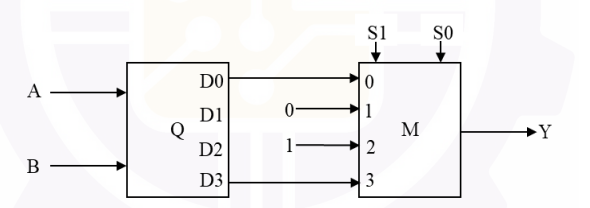
- Match the LIST-I with LIST-IIChoose the correct answer from the options given below:
LIST-I LIST-II A. F(A,B,C,D) = $\sum$ (1,3, 4,11,12,13,14,15) I. 8$\times$1MUX B. F(A,B,C) = $\sum$ (1,2,6,7) II. 4$\times$1MUX C. F(A,B,C) = $\sum$ (1,3,5,7) III. 4$\times$1MUX and 1 NOT gate D. F(A,B,C,D) = $\sum$ (1,3,5,7,9,11,13,15) IV. 8$\times$1MUX and 1 NOT gate Consider the following statements :
A multiplexer :
1. selects one of the several inputs and transmits it to a single output.
2. routes the data from a single input to one of many outputs.
3. converts parallel data into serial data.
4. is a combinational circuit.Which of these statements are correct ?
For the given 4 × 1 MUX, the output y is
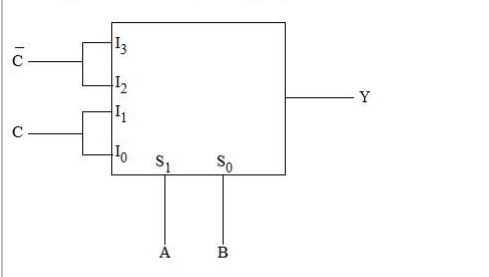
Following multiplexers have to be designed by different MUX. Arrange the number of MUX required in descending order
A. Construct 4 : 1 MUX by using 2 : 1 MUX
B. Construct 16 : 1 MUX by using 4 : 1 MUX
C. Construct 64 : 1 MUX by using 4 : 1 MUX
D. Construct 64 : 1 MUX by using 8 : 1 MUX
E. Construct 256 : 1 MUX by using 8 : 1 MUX
Choose the correct answer from the options given below :


