
The 12 musical notes are given as C, C#, D, D#, E, F, F#, G, G#, A, A#. Frequency of each note is $ \sqrt[12]{2} $ times the frequency of the previous note. If the frequency of the note C is 130.8 Hz, then the ratio of frequencies of notes F# and C is:
Musical Note Frequency Ratio Calculation
The frequencies of musical notes in the standard western scale follow a geometric progression. There are 12 notes in an octave, and the frequency ratio between any two adjacent notes is constant.
The problem states that the frequency multiplier between adjacent notes is $ \sqrt[12]{2} $. We need to find the ratio between the frequencies of F# and C.
Identifying Intervals Between Notes
Let's determine the number of steps (intervals) from note C to note F# in the sequence:
- C (Starting Note)
- C# (1 step)
- D (2 steps)
- D# (3 steps)
- E (4 steps)
- F (5 steps)
- F# (6 steps)
There are 6 steps from C to F#.
Calculating Frequency Ratio
Since each step corresponds to a frequency multiplication factor of $ \sqrt[12]{2} $, the ratio of the frequency of F# to the frequency of C (which is $ F_{\text{F\#}} / F_{\text{C}} $) is calculated by raising this factor to the power of the number of steps (6).
Ratio $ = (\sqrt[12]{2})^{\text{Number of steps}} $
Ratio $ = (\sqrt[12]{2})^{6} $
Using exponent rules, where $ \sqrt[n]{x} = x^{1/n} $:
Ratio $ = (2^{1/12})^{6} $
Ratio $ = 2^{(1/12) \times 6} $
Ratio $ = 2^{6/12} $
Ratio $ = 2^{1/2} $
Ratio $ = \sqrt{2} $
The frequency of C (130.8 Hz) is given but not needed for calculating the ratio.
Therefore, the ratio of frequencies of notes F# and C is $ \sqrt{2} $.
Important Questions from Powers and Exponents
- The digit in the unit's place of the product $3^{999} \times 7^{1000}$ is __________.
- Which one of the following numbers is exactly divisible by $(11^{13} +1)$?
Consider the following functions for non-zero positive integers, $p$ and $q$.
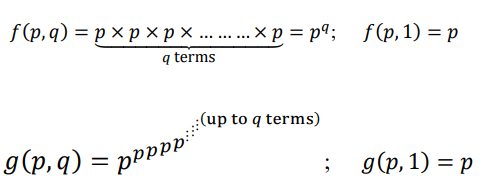
Which one of the following options is correct based on the above?- What is the value of x when $81 \times \left(\frac{16}{25}\right)^{x+2} \div \left(\frac{3}{5}\right)^{2x+4} = 144$?
- What is the value of $\left(\frac{3^{81}}{27^4}\right)^{1/3}$?


