
Solving Divisibility: $11^{13} + 1$
The question asks us to identify which number from the given options is exactly divisible by $11^{13} + 1$. We can solve this using algebraic properties and modular arithmetic.
Identify the Divisor and Substitute
- Let the divisor be $D = 11^{13} + 1$.
- To simplify, let $x = 11^{13}$. Then the divisor $D$ can be written as $x+1$.
- We will now check each option for divisibility by $x+1$. We use the property that $x \equiv -1 \pmod{x+1}$.
Analyze Each Option
-
Option 1: $11^{26}+1$
Rewrite this in terms of $x$: $11^{26}+1 = (11^{13})^2 + 1 = x^2+1$. Now, check the remainder when divided by $x+1$: $x^2+1 \pmod{x+1}$ Since $x \equiv -1 \pmod{x+1}$, substitute $x=-1$: $(-1)^2+1 \equiv 1+1 \equiv 2 \pmod{x+1}$. The remainder is 2, so $11^{26}+1$ is not divisible by $11^{13}+1$.
-
Option 2: $11^{33}+1$
Rewrite this in terms of $x=11^{13}$: $11^{33}+1 = 11^{2 \times 13 + 7} + 1 = (11^{13})^2 \times 11^7 + 1 = x^2 \times 11^7 + 1$. Check the remainder when divided by $x+1$: $x^2 \times 11^7 + 1 \pmod{x+1}$ Substitute $x \equiv -1 \pmod{x+1}$: $(-1)^2 \times 11^7 + 1 \equiv 1 \times 11^7 + 1 \equiv 11^7+1 \pmod{x+1}$. Since $11^7+1$ is not 0, this option is not divisible by $11^{13}+1$.
-
Option 3: $11^{39}-1$
Rewrite this in terms of $x$: $11^{39}-1 = (11^{13})^3 - 1 = x^3-1$. Check the remainder when divided by $x+1$: $x^3-1 \pmod{x+1}$ Substitute $x \equiv -1 \pmod{x+1}$: $(-1)^3-1 \equiv -1-1 \equiv -2 \pmod{x+1}$. The remainder is -2, so $11^{39}-1$ is not divisible by $11^{13}+1$.
-
Option 4: $11^{52}-1$
Rewrite this in terms of $x$: $11^{52}-1 = (11^{13})^4 - 1 = x^4-1$. Check the remainder when divided by $x+1$: $x^4-1 \pmod{x+1}$ Substitute $x \equiv -1 \pmod{x+1}$: $(-1)^4-1 \equiv 1-1 \equiv 0 \pmod{x+1}$. The remainder is 0. Therefore, $11^{52}-1$ is exactly divisible by $11^{13}+1$.
Conclusion
Based on the analysis, the number $11^{52}-1$ is exactly divisible by $11^{13}+1$.
Important Questions from Powers and Exponents
- The digit in the unit's place of the product $3^{999} \times 7^{1000}$ is __________.
Consider the following functions for non-zero positive integers, $p$ and $q$.
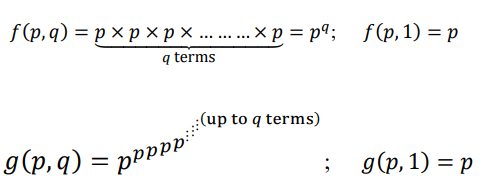
Which one of the following options is correct based on the above?- What is the value of x when $81 \times \left(\frac{16}{25}\right)^{x+2} \div \left(\frac{3}{5}\right)^{2x+4} = 144$?
- What is the value of $\left(\frac{3^{81}}{27^4}\right)^{1/3}$?
- The numeral in the units position of $211^{870} + 146^{127} \times 3^{424}$ is ________


