
Question
Consider the following functions for non-zero positive integers, $p$ and $q$. 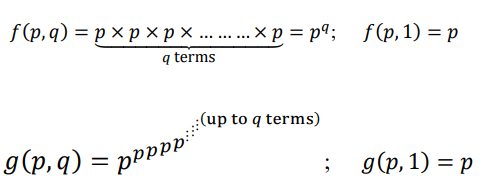
Which one of the following options is correct based on the above?
The correct answer is
$f(2,2) = g(2,2)$
To solve the problem, we need to evaluate and compare the functions \(f(p, q)\) and \(g(p, q)\) for the given pairs of positive integers \(p\) and \(q\).
The definitions of the functions are:
- \(f(p, q) = p^q\)
- \(g(p, q) = \underbrace{pppp \ldots}_{q \text{ terms}} = p^{ \text{product of } q \text{ numbers} } = p^q\)
Next, we evaluate the options:
- Option 1: \(f(2,2) = g(2,2)\)
\(f(2, 2) = 2^2 = 4\)
\(g(2, 2) = 2^2 = 4\)
So, \(f(2,2) = g(2,2)\) is correct. - Option 2: \(f(g(2,2), 2) < f(2,g(2,2))\)
\(g(2, 2) = 4\) (as calculated above)
\(f(4, 2) = 4^2 = 16\)
\(f(2, 4) = 2^4 = 16\)
So, \(f(g(2,2), 2) = f(2,g(2,2))\) is incorrect. - Option 3: \(g(2,1) = f(2,1)\)
\(g(2, 1) = 2\) (since it's a product of one term)
\(f(2, 1) = 2\)
So, \(g(2,1) = f(2,1)\) is correct, but not the provided answer option. - Option 4: \(f(3,2) > g(3,2)\)
\(f(3, 2) = 3^2 = 9\)
\(g(3, 2) = 3^2 = 9\)
So, \(f(3,2) = g(3,2)\) is incorrect.
Therefore, the correct answer is indeed Option 1: \(f(2,2) = g(2,2)\).
Was this answer helpful?
Important Questions from Powers and Exponents
- The digit in the unit's place of the product $3^{999} \times 7^{1000}$ is __________.
- Which one of the following numbers is exactly divisible by $(11^{13} +1)$?
- What is the value of x when $81 \times \left(\frac{16}{25}\right)^{x+2} \div \left(\frac{3}{5}\right)^{2x+4} = 144$?
- What is the value of $\left(\frac{3^{81}}{27^4}\right)^{1/3}$?
- The numeral in the units position of $211^{870} + 146^{127} \times 3^{424}$ is ________
Need Expert Advice?


