
Solving the Exponential Equation for x
We are asked to find the value of x in the equation: $81 \times \left(\frac{16}{25}\right)^{x+2} \div \left(\frac{3}{5}\right)^{2x+4} = 144$
Simplify the Equation
-
Rewrite terms with common bases. Notice that $81 = 3^4$ and $144 = 12^2 = (3 \times 4)^2 = 3^2 \times 4^2$. Also, $\frac{16}{25} = \left(\frac{4}{5}\right)^2$. Substitute these into the equation:
$3^4 \times \left(\left(\frac{4}{5}\right)^2\right)^{x+2} \div \left(\frac{3}{5}\right)^{2x+4} = 3^2 \times 4^2$ -
Apply the power of a power rule ($(a^m)^n = a^{mn}$) and simplify the exponent:
$3^4 \times \left(\frac{4}{5}\right)^{2(x+2)} \div \left(\frac{3}{5}\right)^{2x+4} = 3^2 \times 4^2$ $3^4 \times \left(\frac{4}{5}\right)^{2x+4} \div \left(\frac{3}{5}\right)^{2x+4} = 3^2 \times 4^2$ -
Combine the terms with the same exponent using the rule $\frac{a^n}{b^n} = \left(\frac{a}{b}\right)^n$. First, isolate the combined exponential term:
$\left(\frac{4}{5}\right)^{2x+4} \div \left(\frac{3}{5}\right)^{2x+4} = \frac{3^2 \times 4^2}{3^4}$ $\left(\frac{4/5}{3/5}\right)^{2x+4} = \frac{4^2}{3^2}$ $\left(\frac{4}{3}\right)^{2x+4} = \left(\frac{4}{3}\right)^2$
Solve for x
-
Since the bases are the same ($\frac{4}{3}$), equate the exponents:
$2x+4 = 2$ -
Solve the linear equation for x:
$2x = 2 - 4$ $2x = -2$ $x = \frac{-2}{2}$ $x = -1$
The value of x is -1.
Important Questions from Powers and Exponents
- The digit in the unit's place of the product $3^{999} \times 7^{1000}$ is __________.
- Which one of the following numbers is exactly divisible by $(11^{13} +1)$?
Consider the following functions for non-zero positive integers, $p$ and $q$.
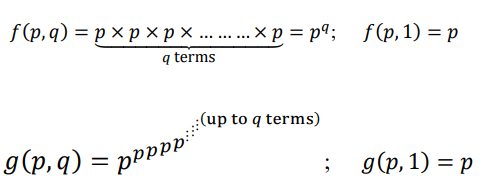
Which one of the following options is correct based on the above?- What is the value of $\left(\frac{3^{81}}{27^4}\right)^{1/3}$?
- The numeral in the units position of $211^{870} + 146^{127} \times 3^{424}$ is ________


