
Statement B. Once the channel capacity is exceeded the flow spreads over a much larger area and the Manning roughness coefficient decreases.
Choose the correct option
Manning Roughness Coefficient Analysis
This solution evaluates two statements concerning the Manning roughness coefficient ($n$) and its relationship with flow conditions.
Analysis of Statement A
Incorrectness of Statement A
Statement A claims that the Manning roughness coefficient ($n$) increases as flow depth increases up to bankfull discharge. This is generally incorrect.
- The Manning coefficient ($n$) is primarily a function of the channel's boundary material (e.g., soil, gravel, vegetation) and geometry.
- It does not typically increase directly with flow depth within the channel. While hydraulic radius and flow velocity change with depth, $n$ is often treated as constant for a given channel section unless conditions like significant sediment transport or vegetation growth occur.
Analysis of Statement B
Incorrectness of Statement B
Statement B states that when channel capacity is exceeded, flow spreads over a larger area, causing the Manning roughness coefficient ($n$) to decrease. This is also incorrect.
- Overbank flow occurs when discharge exceeds the channel's capacity, spreading onto the floodplain.
- Floodplains often have much higher roughness due to vegetation, buildings, and uneven terrain compared to the main channel bed.
- While the flow area increases, the resistance offered by the floodplain surface typically does not lead to a decrease in the *effective* Manning roughness. It might remain similar or even increase, depending on the floodplain's characteristics. The assertion of a definite decrease is inaccurate.
Conclusion
Both Statement A and Statement B present inaccurate descriptions of how the Manning roughness coefficient behaves under different flow conditions. Therefore, the correct conclusion is that both statements are incorrect.
Important Questions from Geomorphology
- Match the following
A Evaporites O Ventifacts B Deflation P Desert varnish C Sandblasting Q Playa D Weathering R Desert pavement E Streamlined hills S Yardangs - Match List-I with List –II and select the correct answer using the codes given below the lists
List-I List-II A Bajada P Aeolian B Dreikanter Q Desert C Karn R Glacial D Dolines S Karst Indentify the sand dune forms that are likely to develop
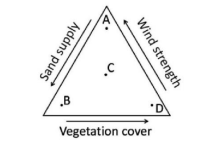
- If L=sediment load, $\text{D}_{50}$=median sediment size, $\bar{Q}$=mean discharge and S=slope then which one of the following relationships is correct?
- Unpaired non-cyclic river terraces are NOT associated with


