
B
Understanding the Seating Arrangement
This problem involves arranging six people, named A, B, C, D, E, and F, in a single row. We are given specific clues about the relative positions of A, B, and C:
- B is somewhere to the right of A. This means A comes before B in the row (A...B).
- B is somewhere to the left of C. This means B comes before C in the row (B...C).
Combining these clues, we know the sequence must follow the pattern: A ... B ... C.
Identifying the Middle Position
A row with six people has positions numbered 1, 2, 3, 4, 5, 6.
In a row of an even number of people (like 6), there isn't one single middle person. Instead, there are two middle positions:
- The 3rd position
- The 4th position
The question asks who is in the middle, implying one of these two positions.
Analyzing Possible Positions for B
We need to find arrangements where B is in either the 3rd or 4th position, while respecting the A...B...C order.
Let's consider where the A B C sequence can fit within the 6 positions:
- If A B C occupy the first three spots (positions 1, 2, 3), the row might look like A B C D E F. The middle positions are the 3rd (occupied by C) and 4th (occupied by D). In this case, B is not in a middle position.
- If A B C occupy positions 2, 3, 4 (for example, D A B C E F), the middle positions are the 3rd (occupied by B) and 4th (occupied by C). Here, B is in a middle position.
- If A B C occupy positions 3, 4, 5 (for example, D E A B C F), the middle positions are the 3rd (occupied by A) and 4th (occupied by B). Here, B is also in a middle position.
- If A B C occupy the last three spots (positions 4, 5, 6), the row might look like D E F A B C. The middle positions are the 3rd (occupied by F) and 4th (occupied by A). In this case, B is not in a middle position.
The clues only establish the relative order of A, B, and C (A...B...C). The positions of D, E, and F are not specified, but they can be arranged around A, B, C.
As demonstrated above, arrangements exist where B occupies the 3rd position (e.g., D A B C E F) or the 4th position (e.g., D E A B C F). In both these valid scenarios, B is located in one of the two middle spots of the row.
Conclusion on Middle Position
Given the constraints that B must be to the right of A and to the left of C, it is possible to construct valid seating arrangements for the six people where B is positioned in either the 3rd or 4th spot, which are the middle positions in a row of six.
Similar Questions
- Seven people - P, Q, R, S, T, U, and V are sitting in a row facing North.
S is fourth to the left of V.
Only one person sits between T and S.
P is not next to T.
R is not at any extreme end.
U is to the immediate left of V.
Question: Who is sitting exactly in the middle? Six students are sitting around a circular table facing the centre. Diya is sitting second to the left of Arjun. Pawan is sitting second to the right of Bhim. Kapil is sitting second to the left of Diya. Diya is an immediate neighbour of both Pawan and Ram. Who is the immediate neighbour of both Pawan and Bhim?
- Which of the following numbers will replace the question mark (?) in the given series?
23, 54, 81, 117, 137, 182, 191, ? - A, E, O, R, S and T are sitting around a circular table facing the centre(but not necessarily in the same order). Only one person sits between A and S. Only two people sit between S and E. R sits second to the left of E. T sits second to the left of A. Who is sitting to the immediate left of O?
- Five persons are sitting in a straight line facing north. S is second to the left of T. R is to the immediate right of T. U is not sitting at any end. Who is sitting in the middle?
- Six friends A, B, C, D, E, and F are sitting in a row. C is sitting to the immediate right of A. D is not at any end. B is sitting between D and E. F is sitting at one of the ends. Who is sitting to the immediate left of B?
- Eight persons - A, B, C, D, E, F, G, H are sitting around a circular table facing the center.
C is third to the right of A.
E is second to the left of C.
B is opposite A.
D is to the immediate right of B.
G is second to the right of F, who is not an immediate neighbor of A.
Who is sitting to the immediate left of D? - Six sports persons are sitting around a circular table facing the centre. R is sitting second to the right of M. Only two people are sitting between R and K. V is sitting second to the right of S. N is an immediate neighbour of both K and V. Who is the immediate neighbour of both M and R?
- H, I, J, K, L and M are sitting around a circular table facing the centre (but not necessarily in the same order). Only two people sit between L and M. M is the immediate neighbour of I and J. H sits to the immediate right of I. How many people sit between K and H when counted from the left of K?
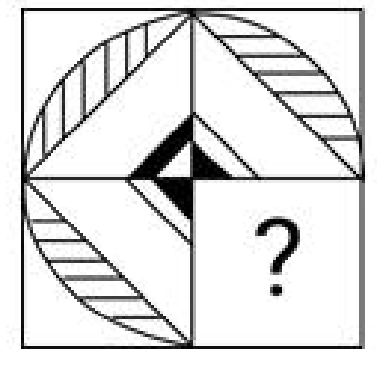
Select the option figure that will replace the question mark (?) in the figure given below and complete the pattern.
Important Questions from Seating arrangement
- A, B, C, D, E and F are sitting around a circular table facing the centre. C sits to the immediate left of E. F is an immediate neighbour of A and C. D is not an immediate neighbour of E. What is the position of D with respect to F?
- Seven people, I, J, K, L, M, N and O, are sitting in a row, facing north. Only three people sit between M and J. O sits to the immediate left of J. No one sits to the right of I. Only two people sit between I and O. N sits to the immediate right of L. How many people sit between K and N?
- A, B, C, D, E, F, and G are sitting around a circular table facing the centre.
Only two people sit between A and G when counted from the right of A. Only two people sit between G and C. Only three people sit between A and F. E sits to the immediate left of D.
How many people sit between C and E when counted from the right of C? Eight people, S, T, U, V, W, X, Y and Z, are sitting in a straight line. All are facing towards the north. S sits third from the extreme left end of the line. W is an immediate neighbour of V. Only U sits between S and W. Z is sitting at the extreme right end of the line. T is an immediate neighbour of both Y and S. How many people sit to the right of W?
L, M, N, O, Q, R and S are sitting around a circular table, facing the centre of the table. Only one person sits between Q and S when counted from the right of Q. Only one person sits between S and N. Only one person sits between Q and R. Only two people sit between L and N. Only one person sits between O and R. Who sits third to the right of M?



