
C is third to the right of A.
E is second to the left of C.
B is opposite A.
D is to the immediate right of B.
G is second to the right of F, who is not an immediate neighbor of A.
Who is sitting to the immediate left of D?
Circular Seating Arrangement Logic Puzzle
This problem involves determining the seating positions of eight people (A, B, C, D, E, F, G, H) around a circular table, with everyone facing the center. The goal is to identify the person sitting immediately to the left of D using a series of clues.
Analyzing the Clues Step-by-Step
We need to carefully deduce the arrangement based on the relative positions provided. Let's represent the seats around the table and place individuals according to the clues. We'll assume a clockwise direction for 'right' and an anti-clockwise direction for 'left' as they face the center.
- Total People: 8 (A, B, C, D, E, F, G, H)
- Setup: Circular table, all facing the center.
- Clue 1: C is third to the right of A.
- Clue 2: E is second to the left of C.
- Clue 3: B is opposite A.
- Clue 4: D is to the immediate right of B.
- Clue 5: G is second to the right of F.
- Clue 6: F is not an immediate neighbor of A.
Building the Arrangement
Let's place the individuals sequentially:
- Start with A: Imagine placing A at a specific position (e.g., the top position).
- Place C: "C is third to the right of A". Counting 3 positions clockwise from A, we place C. If A is at position 1, C is at position 4 (1 -> 2 -> 3 -> 4).
- Place E: "E is second to the left of C". Counting 2 positions anti-clockwise from C, we place E. If C is at 4, left is 3, second left is 2. So E is at position 2.
- Place B: "B is opposite A". In an 8-person circle, the opposite position is 4 seats away. If A is at 1, B is at position 5.
- Place D: "D is to the immediate right of B". Placing D one position clockwise from B. If B is at 5, D is at position 6.
After placing A, C, E, B, and D, the arrangement looks like this (clockwise, starting from A):
A, E, _, C, _, B, D, _
The empty seats are at positions between E and C (Pos 3), between C and B (Pos 5), and between D and A (Pos 8).
Using Remaining Clues to Place F, G, and H
We need to place F, G, and H in the remaining seats (3, 5, and 8) using the last two clues:
- "G is second to the right of F"
- "F is not an immediate neighbor of A"
Analyze "F is not an immediate neighbor of A": A's neighbors are at positions 8 (left) and 2 (right). Position 2 is occupied by E. Therefore, F cannot be in position 8.
This leaves positions 3 and 5 for F.
- Test F at Position 3: The arrangement becomes A, E, F, C, _, B, D, _. Position 5 is empty. Now place G using "G is second to the right of F". From F (at 3), the first right is C (at 4), and the second right is the person at position 5. So, G is at position 5. The arrangement is A, E, F, C, G, B, D, _. The last person, H, must be at position 8. The full clockwise arrangement is: A, E, F, C, G, B, D, H. Let's verify: G (at 5) is second right of F (at 3)? Yes (F -> C -> G). F (at 3) is not a neighbor of A (at 1)? Yes (neighbors are H at 8 and E at 2). This arrangement is valid.
- Test F at Position 5: The arrangement becomes A, E, _, C, F, B, D, _. Position 3 is empty. Now place G using "G is second to the right of F". From F (at 5), the first right is B (at 6), and the second right is D (at 7). But D is already placed at position 7. This placement leads to a contradiction, so F cannot be at position 5.
The only valid seating arrangement (clockwise) is: A, E, F, C, G, B, D, H.
Identifying the Person Left of D
We need to find who is sitting to the immediate left of D.
In our confirmed clockwise arrangement (A, E, F, C, G, B, D, H):
- D is at position 7.
- The person to the immediate right of D (clockwise) is H (at position 8).
- Since everyone faces the center, the immediate left of D corresponds to the person just before D in the clockwise sequence.
- The person immediately preceding D in the sequence is B (at position 6).
Final Answer Determination
Following the logical placement based on the clues, B is the person sitting to the immediate left of D.
Similar Questions
- H, I, J, K, L and M are sitting around a circular table facing the centre (but not necessarily in the same order). Only two people sit between L and M. M is the immediate neighbour of I and J. H sits to the immediate right of I. How many people sit between K and H when counted from the left of K?
- Six people A-F are sitting in a circle. A is second to the left of B. C is opposite A. D is between C and E. Who is to the immediate right of B?
- Seven people G, H, I, J, K, L, and M are sitting in a straight line facing North.
H is sitting fourth to the left of K.
J is to the immediate right of I.
Only one person sits between M and G.
I is not an immediate neighbor of H.
Who sits at the extreme left end? - Seven people - P, Q, R, S, T, U, and V are sitting in a row facing North.
S is fourth to the left of V.
Only one person sits between T and S.
P is not next to T.
R is not at any extreme end.
U is to the immediate left of V.
Question: Who is sitting exactly in the middle? - Eight friends A, B, C, D, E, F, G, and H are sitting around a circular table facing the center.
A is second to the left of D.
B is to the immediate right of A.
C is opposite B.
F is between C and D.
G is to the immediate right of H.
H is not an immediate neighbor of D.
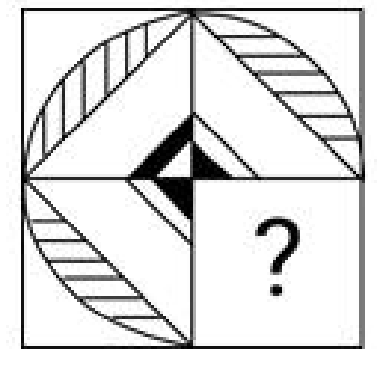
Who is sitting to the immediate left of H? Select the option figure that will replace the question mark (?) in the figure given below and complete the pattern.
- Seven persons sit in a circle, all facing outward.
P sits to the immediate right of Q.
R is second to the left of Q.
S is between P and T.
U is opposite R.
Who is to the immediate left of T? - Five friends A, B, C, D, and E sit around a circular table facing the center,
B sits to the immediate right of A.
C is to the immediate right of B.
D is to the immediate left of E.
E is opposite A.
Question: Who is sitting to the immediate left of C? - Seven people - A, B, C, D, E, F, and G - are sitting in a row. All are facing north. C is sitting to the immediate right of D, who is third from the left. How many people are sitting to the right of C?
Six students are sitting around a circular table facing the centre. Diya is sitting second to the left of Arjun. Pawan is sitting second to the right of Bhim. Kapil is sitting second to the left of Diya. Diya is an immediate neighbour of both Pawan and Ram. Who is the immediate neighbour of both Pawan and Bhim?
Important Questions from Seating arrangement
Five people A, B, C, D and E are seated about a round table. Every chair is spaced equidistant from adjacent chairs.
(i) C is seated next to A
(ii) A is seated two seats from D
(iii) B is not seated next to A
On the basis of above information, which of the following must be true?
1. D is seated next to B
2. E is seated next to A
3. D and C are separated by two seats
Select the correct answer using the code given below:
There are seven persons up on a ladder, A, B, C, D, E, F and G (not in that order). A is further up than E but is lower than C. B is in the middle. G is between A and B. E is between B and F. If F is between E and D, the person on the bottom step of the ladder will be
Consider that:
1. A is taller than B.
2. C is taller than A.
3. D is taller than C.
4. E is the tallest of all.
If they are made to sit in the above order of their height, who will occupy the mid position?
Four children are sitting in a row. A is occupying the seat next to B but not next to C. If C is not sitting next to D, who is/are occupying seat/seats adjacent to D?
A question paper must have a question on one of the eight poets: A, B, C, D, E, F, G or H The first four belong to the medieval period while the rest are considered modern poets Generally, modern poets figure in the question paper in alternate years. Generally those who like H like G also; and those who like F like E also. The paper-setter does not like to ask about F as he has written a book on F, but he likes F. Last year, the paper contained a question on A.
On the basis of the information given, this year's paper is most likely to contain a question on



