
Select the option that represents the letters which, when sequentially placed from left to right in the blanks below, will complete the letter series: f d _ e _ e f _ d d _ d _ f f _ d _ d _ f
d d f e e d e e
To solve this problem, we need to find the correct sequence of letters that fill in the blanks of the letter series: f d _ e _ e f _ d d _ d _ f f _ d _ d _ f. The given options are:
- d d f e e d e d
- d d f e f d e e
- d d f d e d e f
- d d f e e d e e
Let's analyze the pattern in the given letter series:
- The series consists of sequence repetitions. We look for a cyclic pattern.
- By examining the given sequence, observe the segment "f d _ e _ e f", which appears to repeat in similar patterns.
Let's check the given correct answer option: d d f e e d e e.
- Substitute the blanks with "d d f e e d e e", we get the sequence: f d d e e e f d d f d e f f e d e d e f.
- This forms a repeating pattern: f d d e e e f.
- The next section, starting with 'e', correctly continues to form a similar sequence pattern.
Thus, we confirm the sequence follows a repeating pattern. Based on cyclic repetitions, the appropriate option is d d f e e d e e.
Hence, the correct answer is:
| d d f e e d e e |
This pattern ensures the logical consistency of the sequence with identically repeating sections, validating the answer choice.
Similar Questions
Select the number from among the given options that can replace the question mark (?) in the following series.
9, 5, 6, 10.5, 23, ?
Select the option that represents the letters that, when sequentially placed from left to right in the blanks below, will complete the letter series.
_ D R G _ Z D R _ B Z D _ G B Z _ R G B
Given below is a statement followed by two possible reasons numbered I and II. Read the statement carefully and decide which of the two explain(s) the event/observation/information given in the statement.
Statement:
In India, large cities have attracted migrant population from across rural parts of the country. According to 2011 census, in India’s six largest metros (Delhi, Mumbai, Chennai, Bengaluru, Kolkata and Hyderabad), approximately 48% of the residents were migrants.Reasons:
I) Migration happens due to availability of better career and economic prospects in cities.
II) Migration happens because people like travelling and exploring new cities.What should come in place of the question mark (?) in the given series?
18, 74, 298, 1194, 4778, ?Select the option that represents the letters that when sequentially placed from left to right in the blanks below will complete the letter series.
_ _ C _ D C _ _ C C _ _
Select the number from among the given options that can replace the question mark (?) in the following series:
98, 50, 26, 14, ?, 5
ADBC : EHFG : : ILJK : ?
Identify the figure given in the options which when put in place of the question mark (?) will logically complete the series?
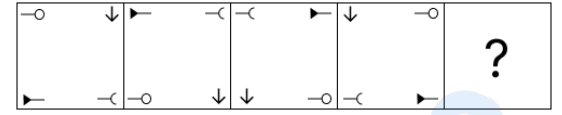
All of the letters in the word ‘FROWNED’ are arranged in alphabetical order. How many letters are there in the English alphabetical series between the letter which is fourth from the left end and the one which is second from the right end in the new letter-cluster thus formed?
Which of the four options will replace the question mark (?) in the following series?
XF 11, YI 15, ZL 19, AO 23, ?
Important Questions from Sequence & Series
Which of the following options should come in place of the question mark (?) in the given series based on the English alphabetical order?
SHK, WLO, APS, ETW,?
Which of the following options should come in place of the question mark (?) in the given series based on the English alphabetical order?
EGI, KMO, QSU, WYA,?
Which of the following options should come in place of the question mark (?) in the given series?
14 15 18 23 30?
Two sets of numbers are given below. In each set of numbers, certain mathematical operation(s) on the first number result(s) in the second number. Similarly, certain mathematical operation(s) on the second number result(s) in the third number and so on. Which of the given options follows the same set of operations as in the given sets? (NOTE: Operations should be performed on the whole numbers, without breaking down the numbers into their constituent digits. E.g. 13 – Operations on 13 such as adding/subtracting/multiplying to 13 can be performed. Breaking down 13 into 1 and 3 and then performing mathematical operations on 1 and 3 is not allowed.)
What should come in place of the question mark (?) in the given series based on the English alphabetical order?
TAW VCY XEA ZGC ?



