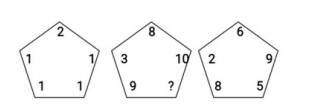
Select the option that can replace the question mark (?) in the third row. Row1: 6, 4, 26 Row2: 3, 7, 29 Row3: 2, 6, ?
20
Analysing the Numerical Pattern in Rows
The question asks us to identify the pattern connecting the numbers in each row and use it to find the missing number in the third row. We are given three rows of numbers:
- Row 1: 6, 4, 26
- Row 2: 3, 7, 29
- Row 3: 2, 6, ?
We need to find a relationship between the first two numbers in a row that results in the third number.
Identifying the Pattern Rule
Let's analyze the first two rows to find a consistent rule. Let the first number in a row be \(a\), the second number be \(b\), and the third number be \(c\). We are looking for a relationship \(f(a, b) = c\). Simple arithmetic operations or combinations might be involved.
Let's test a common type of pattern, a linear combination of the first two numbers, potentially with a constant:
\(k_1 a + k_2 b + k_3 = c\)
For Row 1 (a=6, b=4, c=26):
\(6k_1 + 4k_2 + k_3 = 26\) (Equation 1)
For Row 2 (a=3, b=7, c=29):
\(3k_1 + 7k_2 + k_3 = 29\) (Equation 2)
We can subtract Equation 1 from Equation 2 to eliminate \(k_3\):
\((3k_1 + 7k_2 + k_3) - (6k_1 + 4k_2 + k_3) = 29 - 26\)
\(-3k_1 + 3k_2 = 3\)
Dividing by 3:
\(-k_1 + k_2 = 1\) (Equation 4)
Now consider the third row with the unknown value as \(c\):
For Row 3 (a=2, b=6, c=?):
\(2k_1 + 6k_2 + k_3 = ?\) (Equation 3)
If we assume one of the options (20, 10, 23, 28) is the correct value for the third row, we can form a third equation and solve for \(k_1, k_2, k_3\). Let's assume the missing number is 20 (Option 1).
If c = 20 for Row 3:
\(2k_1 + 6k_2 + k_3 = 20\) (Equation 3')
Subtract Equation 3' from Equation 2:
\((3k_1 + 7k_2 + k_3) - (2k_1 + 6k_2 + k_3) = 29 - 20\)
\(k_1 + k_2 = 9\) (Equation 5)
Now we have a system of two linear equations for \(k_1\) and \(k_2\) using Equation 4 and Equation 5:
- \( -k_1 + k_2 = 1 \)
- \( k_1 + k_2 = 9 \)
Adding these two equations:
\( (-k_1 + k_2) + (k_1 + k_2) = 1 + 9 \)
\( 2k_2 = 10 \)
\( k_2 = 5 \)
Substitute \(k_2 = 5\) into Equation 5:
\( k_1 + 5 = 9 \)
\( k_1 = 4 \)
Now substitute \(k_1 = 4\) and \(k_2 = 5\) into Equation 1 (or 2) to find \(k_3\):
\(6(4) + 4(5) + k_3 = 26\)
\(24 + 20 + k_3 = 26\)
\(44 + k_3 = 26\)
\(k_3 = 26 - 44\)
\(k_3 = -18\)
The potential pattern is \(4a + 5b - 18 = c\).
Applying the Pattern to Find the Missing Number
Let's verify if the pattern \(4a + 5b - 18 = c\) holds for the first two rows:
For Row 1 (6, 4, 26):
\(4 \times 6 + 5 \times 4 - 18 = 24 + 20 - 18 = 44 - 18 = 26\)
The pattern holds for Row 1.
For Row 2 (3, 7, 29):
\(4 \times 3 + 5 \times 7 - 18 = 12 + 35 - 18 = 47 - 18 = 29\)
The pattern holds for Row 2.
Since the pattern \(4a + 5b - 18 = c\) works for both the given rows, we can apply it to the third row to find the missing number.
For Row 3 (2, 6, ?):
Here, \(a = 2\) and \(b = 6\). We need to find \(c\).
\(c = 4 \times 2 + 5 \times 6 - 18\)
\(c = 8 + 30 - 18\)
\(c = 38 - 18\)
\(c = 20\)
Step-by-Step Solution Calculation
1. Identify the numbers in the rows: (6, 4, 26), (3, 7, 29), (2, 6, ?).
2. Assume a pattern form, such as \(k_1 a + k_2 b + k_3 = c\).
3. Use the first two rows to set up equations:
- \(6k_1 + 4k_2 + k_3 = 26\)
- \(3k_1 + 7k_2 + k_3 = 29\)
4. Assume one of the answer options for the third row (e.g., 20) to get a third equation:
- \(2k_1 + 6k_2 + k_3 = 20\)
5. Solve the system of equations to find the values of \(k_1, k_2, k_3\):
- Subtracting equations leads to \(k_1 = 4, k_2 = 5\).
- Substituting back gives \(k_3 = -18\).
6. Confirm the derived pattern \(4a + 5b - 18 = c\) works for the first two rows.
- Row 1: \(4(6) + 5(4) - 18 = 24 + 20 - 18 = 26\) (Correct)
- Row 2: \(4(3) + 5(7) - 18 = 12 + 35 - 18 = 29\) (Correct)
7. Apply the confirmed pattern to the third row (2, 6, ?):
- Missing number = \(4(2) + 5(6) - 18 = 8 + 30 - 18 = 38 - 18 = 20\).
Conclusion: The Missing Number
Based on the consistent pattern found in the first two rows, the missing number in the third row is 20.
This matches Option 1.
Revision Table: Key Pattern Details
| Row | First Number (a) | Second Number (b) | Third Number (c) | Pattern: \(4a + 5b - 18\) | Verification |
|---|---|---|---|---|---|
| 1 | 6 | 4 | 26 | \(4(6) + 5(4) - 18 = 24 + 20 - 18 = 26\) | Correct |
| 2 | 3 | 7 | 29 | \(4(3) + 5(7) - 18 = 12 + 35 - 18 = 29\) | Correct |
| 3 | 2 | 6 | ? | \(4(2) + 5(6) - 18 = 8 + 30 - 18 = 20\) | Result |
Additional Information: Exploring Number Patterns
Number pattern questions in reasoning and quantitative aptitude tests often involve finding the relationship between numbers in a sequence, row, or grid. Common patterns include:
- Arithmetic Progression: Adding or subtracting a constant value.
- Geometric Progression: Multiplying or dividing by a constant value.
- Differences: Finding patterns in the differences between consecutive terms.
- Multiplication and Addition/Subtraction: Combinations like \(a \times b + k = c\), \(a \times b + a = c\), \(a \times b + b = c\), etc.
- Squares and Cubes: Patterns involving \(a^2, b^2, a^3, b^3\) or combinations.
- Linear Combinations: Patterns of the form \(k_1 a + k_2 b = c\) or \(k_1 a + k_2 b + k_3 = c\), as seen in this problem.
- Digit-based Operations: Sometimes, operations are performed on the digits of the numbers rather than the numbers themselves (less common in rows/columns unless specified).
Solving these puzzles requires careful observation, testing different hypotheses, and logical deduction. When faced with multiple possible patterns that fit partial data, consider the simplest pattern or the one that leads to an available answer option in a multiple-choice question context.
Similar Questions
In the following question, select the number which can be placed at the sign of question mark (?) from the given alternatives.
2
3
7
8
7
3
6
4
3
5
7
?
Find the missing number from the below options.
3
GNQ
8
3
RBS
9
4
TUA
2
2
FPC
5
3
OLH
?
Find the missing number from the below options.
4
9
9
7
4
?
11
13
19
Find the missing number from the below options.
16
25
81
36
49
9
10
12
?
Find the missing number from the below options.
3
10
5
8
7
?
5
8
Find the missing number from the below options.
7
3
58
8
2
?
Find the missing number from the below options.
117
6
9
?
5
4
Find the missing number from the below options.
8
2
520
7
3
370
6
4
?
Study the given pattern carefully and select the number that can replace the question mark (?) in it.
\(\begin{array}{} {25}&{40}&{10}\\ {81}&9&9\\ ?&{16}&8 \end{array}\)
Study the given pattern carefully and select the number that can replace the question mark (?) in it.
14
9
7
7
4
5
?
10
4
Important Questions from Missing Number in Matrix
- A clock buzzes 1 time at 1 o'clock, 2 times at 2 o'clock, 3 times at 3 o'clock and so on. How many total number of times will it buzz from 12 noon till 11 p.m. (including both)?
What is the value of the missing number?
Consider the following figure :
Find out the missing number from among the following:
Consider the following figure matrix
Study the given pattern carefully and select the number from among the given options that can replace the question mark (?) in it.