
Plane Mirror Image Size
The image size formed by a plane mirror is always equal to the object size. If Sachin's height is denoted by $H$, the image formed in the mirror will also have a height of $H$.
Visible Body Fraction
The fraction of Sachin's body that is visible depends on the size of the mirror and the position of his eyes relative to the mirror. The problem states that at a distance of 20 cm, he sees $\frac{1}{4}$ of his body. This means the visible portion of the image has a height of $\frac{H}{4}$.
Distance Effect on Visibility
When an object is viewed in a plane mirror:
- The size of the image formed remains equal to the object's size ($H$).
- The distance of the image from the mirror is equal to the object's distance from the mirror.
- The size of the mirror does not change.
- The observer's height and eye position relative to their body do not change.
Therefore, the fraction of the observer's body visible in the mirror remains constant, irrespective of the distance from the mirror.
Determining Visible Body Fraction
Since Sachin sees $\frac{1}{4}$ of his body height when he is 20 cm away, the mirror setup allows him to see only that fraction. As the distance change does not alter the visible fraction, he will continue to see $\frac{1}{4}$ of his body when he stands 40 cm away from the mirror.
Important Questions from Geometry (Notes)
- A 6 cm long chord of a circle is at a distance of 4 cm from the centre of the circle. Find the distance of 8 cm long chord of the same circle from the centre.
- In a triangle PQR, if $\angle P + \angle R = 150^\circ$ and $\angle P + 3\angle Q = 170^\circ$, then $\angle P$ is equal to :
- PQR is a triangle. The bisectors of the internal angle $\angle Q$ and external angle $\angle R$ intersect at M. If $\angle QMR = 40^\circ$, then $\angle P$ is :
- A $2\text{ m}$ long ladder is to reach a wall of height $1.75\text{ m}$. The largest possible horizontal distance of the ladder from the wall could be
Three-quarters of a circle is shown in the figure; OA and OB are two radii perpendicular to each other. C is a point on the circle.
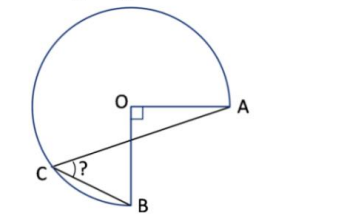
What is angle ACB?


