
Ladder Problem: Applying Pythagorean Theorem
This problem involves a right-angled triangle formed by the ladder, the wall, and the ground. We can use the Pythagorean theorem to find the unknown horizontal distance.
- Let the length of the ladder be the hypotenuse, $L = 2\text{ m}$.
- Let the height of the wall be one leg, $H = 1.75\text{ m}$.
- Let the horizontal distance from the wall be the other leg, $D$.
Calculating Horizontal Distance
According to the Pythagorean theorem: $D^2 + H^2 = L^2$
We need to find $D$. Rearranging the formula:
$D^2 = L^2 - H^2$
Substitute the given values:
$D^2 = (2)^2 - (1.75)^2$
$D^2 = 4 - 3.0625$
$D^2 = 0.9375$
Now, take the square root to find $D$:
$D = \sqrt{0.9375}$
Determining the Correct Option
We need to estimate the value of $\sqrt{0.9375}$.
- We know that $\sqrt{1} = 1$.
- Since $0.9375$ is less than $1$, its square root must also be less than $1$.
- Calculating the value gives $D \approx 0.9682\text{ m}$.
Therefore, the largest possible horizontal distance $D$ is approximately $0.9682\text{ m}$, which is slightly less than $1\text{ m}$.
The correct option is the one describing a distance slightly less than $1\text{ m}$.
Important Questions from Geometry (Notes)
- A 6 cm long chord of a circle is at a distance of 4 cm from the centre of the circle. Find the distance of 8 cm long chord of the same circle from the centre.
- In a triangle PQR, if $\angle P + \angle R = 150^\circ$ and $\angle P + 3\angle Q = 170^\circ$, then $\angle P$ is equal to :
- PQR is a triangle. The bisectors of the internal angle $\angle Q$ and external angle $\angle R$ intersect at M. If $\angle QMR = 40^\circ$, then $\angle P$ is :
Three-quarters of a circle is shown in the figure; OA and OB are two radii perpendicular to each other. C is a point on the circle.
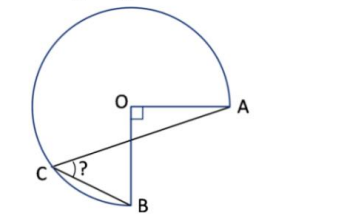
What is angle ACB?
In the context of tiling a plane surface, which of the following polygons is the odd one out?


