
Understanding the Circle Chord Problem
This problem involves a circle and two chords. We are given information about one chord (length and distance from the center) and need to use this to find the distance of another chord (given its length) from the center of the same circle. The key is to realize that the radius of the circle remains constant.
Calculating the Circle's Radius
We can use the properties of a circle and the Pythagorean theorem to find the radius. A line segment drawn from the center of a circle perpendicular to a chord bisects the chord.
- Given: First chord length = 6 cm, Distance from center = 4 cm.
- The perpendicular from the center bisects the chord, so half the length of the first chord is $\frac{6 \text{ cm}}{2} = 3 \text{ cm}$.
- This creates a right-angled triangle with the distance from the center (4 cm) as one leg, half the chord length (3 cm) as the other leg, and the radius (r) as the hypotenuse.
- Using the Pythagorean theorem, $a^2 + b^2 = c^2$: $r^2 = (\text{Distance})^2 + (\text{Half Chord Length})^2$ $r^2 = 4^2 + 3^2$ $r^2 = 16 + 9$ $r^2 = 25$
- Taking the square root of both sides gives the radius: $r = \sqrt{25}$ $r = 5 \text{ cm}$
The radius of the circle is 5 cm.
Finding the Distance of the Second Chord
Now that we know the radius, we can find the distance of the second chord from the center.
- Given: Second chord length = 8 cm, Radius (r) = 5 cm.
- The perpendicular from the center bisects this chord too. Half the length of the second chord is $\frac{8 \text{ cm}}{2} = 4 \text{ cm}$.
- Again, we form a right-angled triangle. The radius (5 cm) is the hypotenuse, half the chord length (4 cm) is one leg, and the distance (d) from the center to the chord is the other leg.
- Applying the Pythagorean theorem: $r^2 = d^2 + (\text{Half Chord Length})^2$ $5^2 = d^2 + 4^2$ $25 = d^2 + 16$
- Rearranging to solve for $d^2$: $d^2 = 25 - 16$ $d^2 = 9$
- Taking the square root gives the distance: $d = \sqrt{9}$ $d = 3 \text{ cm}$
Therefore, the distance of the 8 cm long chord from the center of the circle is 3 cm.
Important Questions from Geometry (Notes)
- In a triangle PQR, if $\angle P + \angle R = 150^\circ$ and $\angle P + 3\angle Q = 170^\circ$, then $\angle P$ is equal to :
- PQR is a triangle. The bisectors of the internal angle $\angle Q$ and external angle $\angle R$ intersect at M. If $\angle QMR = 40^\circ$, then $\angle P$ is :
- A $2\text{ m}$ long ladder is to reach a wall of height $1.75\text{ m}$. The largest possible horizontal distance of the ladder from the wall could be
Three-quarters of a circle is shown in the figure; OA and OB are two radii perpendicular to each other. C is a point on the circle.
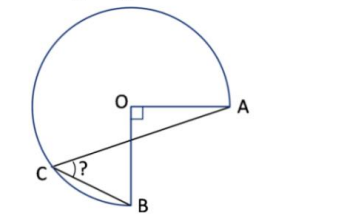
What is angle ACB?
In the context of tiling a plane surface, which of the following polygons is the odd one out?


