
In the context of tiling a plane surface, which of the following polygons is the odd one out?
Tiling Plane Surfaces with Regular Polygons
To determine which regular polygon is the odd one out in tiling a plane surface, we need to check if the polygon can tessellate. A tessellation (or tiling) covers a plane with shapes having no overlaps or gaps. For a regular polygon to tessellate, the sum of the interior angles meeting at any vertex must equal exactly 360 degrees.
Calculating Interior Angles
The formula for the interior angle of a regular n-sided polygon is:
$ \text{Interior Angle} = \frac{(n-2) \times 180^\circ}{n} $
Analyzing Each Polygon
- Equilateral Triangle (n=3):
- Interior Angle = $ \frac{(3-2) \times 180^\circ}{3} = \frac{180^\circ}{3} = 60^\circ $
- Number of triangles meeting at a vertex = $ \frac{360^\circ}{60^\circ} = 6 $.
- Since 6 triangles fit perfectly ($6 \times 60^\circ = 360^\circ$), equilateral triangles can tile a plane.
- Square (n=4):
- Interior Angle = $ \frac{(4-2) \times 180^\circ}{4} = \frac{360^\circ}{4} = 90^\circ $
- Number of squares meeting at a vertex = $ \frac{360^\circ}{90^\circ} = 4 $.
- Since 4 squares fit perfectly ($4 \times 90^\circ = 360^\circ$), squares can tile a plane.
- Regular Pentagon (n=5):
- Interior Angle = $ \frac{(5-2) \times 180^\circ}{5} = \frac{540^\circ}{5} = 108^\circ $
- Number of pentagons meeting at a vertex = $ \frac{360^\circ}{108^\circ} \approx 3.33 $.
- Since $360^\circ$ is not perfectly divisible by $108^\circ$, a whole number of pentagons cannot meet at a vertex without gaps or overlaps. Regular pentagons cannot tile a plane by themselves.
- Regular Hexagon (n=6):
- Interior Angle = $ \frac{(6-2) \times 180^\circ}{6} = \frac{720^\circ}{6} = 120^\circ $
- Number of hexagons meeting at a vertex = $ \frac{360^\circ}{120^\circ} = 3 $.
- Since 3 hexagons fit perfectly ($3 \times 120^\circ = 360^\circ$), regular hexagons can tile a plane.
Conclusion on Tiling
The regular polygons that can tile a plane are the equilateral triangle, the square, and the regular hexagon. The regular pentagon is the odd one out because its interior angles do not allow for a combination that sums to exactly 360 degrees at any vertex, preventing it from forming a tessellation.
Important Questions from Geometry (Notes)
- A 6 cm long chord of a circle is at a distance of 4 cm from the centre of the circle. Find the distance of 8 cm long chord of the same circle from the centre.
- In a triangle PQR, if $\angle P + \angle R = 150^\circ$ and $\angle P + 3\angle Q = 170^\circ$, then $\angle P$ is equal to :
- PQR is a triangle. The bisectors of the internal angle $\angle Q$ and external angle $\angle R$ intersect at M. If $\angle QMR = 40^\circ$, then $\angle P$ is :
- A $2\text{ m}$ long ladder is to reach a wall of height $1.75\text{ m}$. The largest possible horizontal distance of the ladder from the wall could be
Three-quarters of a circle is shown in the figure; OA and OB are two radii perpendicular to each other. C is a point on the circle.
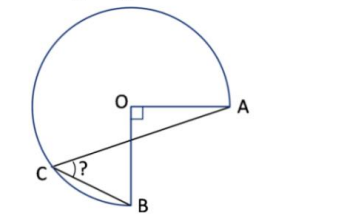
What is angle ACB?


