
Triangle Angle P Calculation
We are given a triangle PQR with the following conditions:
- $ \angle P + \angle R = 150^\circ $ (Equation 1)
- $ \angle P + 3\angle Q = 170^\circ $ (Equation 2)
We know the sum of angles in any triangle is $180^\circ$. Therefore:
$ \angle P + \angle Q + \angle R = 180^\circ $
Step 1: Find Angle Q
Substitute Equation 1 into the triangle angle sum property:
$ ( \angle P + \angle R ) + \angle Q = 180^\circ $ $ 150^\circ + \angle Q = 180^\circ $
Solve for $ \angle Q $:
$ \angle Q = 180^\circ - 150^\circ $
$ \angle Q = 30^\circ $
Step 2: Find Angle P
Now, use Equation 2 and the value of $ \angle Q $ we found:
$ \angle P + 3\angle Q = 170^\circ $
Substitute $ \angle Q = 30^\circ $:
$ \angle P + 3(30^\circ) = 170^\circ $
$ \angle P + 90^\circ = 170^\circ $
Solve for $ \angle P $:
$ \angle P = 170^\circ - 90^\circ $
$ \angle P = 80^\circ $
Thus, $ \angle P $ is $80^\circ$.
Important Questions from Geometry (Notes)
- A 6 cm long chord of a circle is at a distance of 4 cm from the centre of the circle. Find the distance of 8 cm long chord of the same circle from the centre.
- PQR is a triangle. The bisectors of the internal angle $\angle Q$ and external angle $\angle R$ intersect at M. If $\angle QMR = 40^\circ$, then $\angle P$ is :
- A $2\text{ m}$ long ladder is to reach a wall of height $1.75\text{ m}$. The largest possible horizontal distance of the ladder from the wall could be
Three-quarters of a circle is shown in the figure; OA and OB are two radii perpendicular to each other. C is a point on the circle.
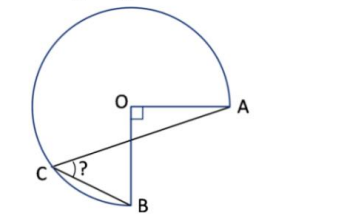
What is angle ACB?
In the context of tiling a plane surface, which of the following polygons is the odd one out?


