
Question
Past high sea levels or shorelines CANNOT be inferred from ________
The correct answer is
Sea stacks
Interpreting Past Sea Levels and Shorelines
The question asks us to identify which geological feature among the given options cannot be used to infer past high sea levels or shorelines. Understanding past sea levels is crucial in geology and coastal studies to reconstruct Earth's history and predict future changes.
Analyzing Evidence for Past Sea Levels
Let's examine each option to see how it relates to indicating past sea levels:
- Marine terraces: These are essentially flat or gently sloping platforms cut by wave erosion at sea level. When the land is uplifted (tectonic activity) or the sea level falls, these platforms are left elevated above the current sea level. A series of marine terraces can indicate periods of stable sea level followed by uplift, making them strong indicators of past high sea levels.
- Raised beaches: Similar to marine terraces, raised beaches are former coastal areas (beaches) that are now found significantly above the present sea level. They represent shorelines that existed when the sea level was higher or the land was lower. Their presence is a direct confirmation of past higher sea levels.
- Strandlines: A strandline is a line of debris (like shells, seaweed, pebbles, and sand) deposited by waves at the highest point of the tide on a beach. Multiple strandlines, one above another, can indicate a stable past high sea level over time or show fluctuations in sea level. They mark former high tide limits, thus indicating past shorelines.
- Sea stacks: A sea stack is a vertical column of rock in the sea, typically formed when wave erosion attacks a headland or cliff. Initially, it might be part of a cave or arch, which eventually collapses, leaving an isolated stack. While sea stacks are formed by wave action at the current sea level, they primarily demonstrate the erosive power of the sea and the resistance of the rock. They don't inherently mark a specific *past high* sea level or shoreline in the way terraces, beaches, or strandlines do. They indicate the current level where significant wave erosion is occurring.
Conclusion on Sea Level Indicators
Based on the analysis:
- Marine terraces indicate past sea levels through uplifted wave-cut platforms.
- Raised beaches are clear markers of former shorelines situated above the current sea level.
- Strandlines show the historical high tide marks, indicating former shoreline positions.
- Sea stacks are primarily products of current wave erosion at sea level and do not directly indicate specific past high sea levels or shorelines.
Therefore, past high sea levels or shorelines CANNOT be inferred from sea stacks.
Was this answer helpful?
Important Questions from Geomorphology
- Match the following
A Evaporites O Ventifacts B Deflation P Desert varnish C Sandblasting Q Playa D Weathering R Desert pavement E Streamlined hills S Yardangs - Match List-I with List –II and select the correct answer using the codes given below the lists
List-I List-II A Bajada P Aeolian B Dreikanter Q Desert C Karn R Glacial D Dolines S Karst Indentify the sand dune forms that are likely to develop
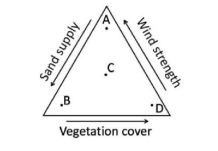
- If L=sediment load, $\text{D}_{50}$=median sediment size, $\bar{Q}$=mean discharge and S=slope then which one of the following relationships is correct?
- Unpaired non-cyclic river terraces are NOT associated with
Need Expert Advice?


