
Operation ‘a = a * b + a’ can also be written as : (a) a *= b + 1 ; (b) (a * b) != (b + a) ; (c) a = (b + 1) * a ; (d) a *= b + a
(a) and (c) are correct.
Factorise the target expression first.
\(a = a\times b + a = a\,(b+1)\)
So any equivalent statement must multiply a by (b + 1).
Statement (a) — correct. A compound assignment in C expands with the whole right-hand side as one operand:
a *= b + 1; ≡ a = a * (b + 1);
This is the key rule of the question. The right-hand expression is evaluated completely before the multiplication, exactly as if it were parenthesised, so a *= b + 1 is not a = a*b + 1. Expanding, a*(b+1) = a*b + a ✓.
Statement (c) — correct. a = (b + 1) * a; is the same product written the other way round, and multiplication is commutative ✓.
Statement (b) — wrong. != is the inequality operator, not an assignment. The line (a * b) != (b + a); merely computes a truth value, discards it and leaves a completely unchanged ✗.
Statement (d) — wrong. By the same expansion rule, a *= b + a; means a = a * (b + a), which is \(ab+a^{2}\), not \(ab+a\). The two agree only in the special case a = 1 ✗.
Step — assemble. (a) and (c) are equivalent, giving option 4.
Check with numbers. Take a = 3, b = 4. The target is \(3\times4+3=15\). Statement (a): 3 * (4+1) = 15 ✓. Statement (c): (4+1) * 3 = 15 ✓. Statement (d): 3 * (4+3) = 21 ✗. One substitution settles the whole question.
The general rule to carry away. For any compound operator, x op= expr is defined as x = x op (expr) — the implied parentheses around the entire right-hand side are what trip people up with *=, /= and -=. Note also that x op= expr evaluates x only once, which matters when the left side has side effects such as arr[i++] *= 2.
Hence, the equivalent forms are (a) and (c).
Similar Questions
The function "isalnum( )" returns a non-zero value if the character is alphanumeric and zero otherwise. What is header file to be used in the main program ?
To read a integer variable, find the correct format given below :
Int m;
Find the correct list, which is the reverse (at all levels) of the given list :
[[4, 7, 8], 2, 9, [19, 6], 20, 3]
(i) 3, 20
(ii) 9, 2
(iii) [6, 19]
(iv) [8, 7, 4]Which of the following is not an infinite loop ?
(A) int i = 1;
while (1)
{
i++ ;
}
(B) for ( ; ; ) ;
(C) int t = 0, f ;while (t)
{
f = 1;
}
(D) int y, x = 0 ;
do
{
y = x;
}
while (x == 0);
The three types of loops available in C language are
i. for
ii. while
iii. do-whileWhich loops do not operate without testing the condition even once ?
Match the following :
List – I List – II a. associativity i. memory storage b. # define ii. if-then-else c. auto iii. operators with equal precedence d. conditional operator iv. define operator Codes :
Assertion (A) : 'C' uses many data types such as integers (short and long) and float etc.
Reason (R) : Conversion specifier used for short unsigned integer is % lu.
Which bitwise operator is suitable for turning off a particular bit in a number ?
Which storage class is used for the variables that are often required in a program ?
Which is not a proper way of array declaration ?
Important Questions from Miscellaneous
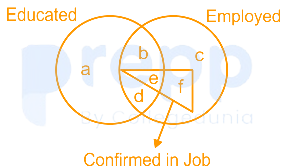
Read the given figure and find the region representing persons who are educated and employed but not confirmed in job.
The magazine in which Mahatma Gandhi mentioned what he wanted the Constitution to do is:
Which gas shields the surface of the earth from ultraviolet radiation from the sun?
Which event is marked as an Intangible Cultural Heritage of Humanity by UNESCO?
Who has been conferred with the rank of the Commander of the Order of the British Empire in 2018?



