Netslip vs. Separation Vector Magnitude on Fault Planes
The question asks how the magnitude of the netslip vector compares to the magnitude of the separation vector on a fault plane.
Understanding the Vectors
- Netslip Vector: Represents the true, total displacement (slip) that occurs within the fault plane itself. Its magnitude is the total amount of slip.
- Separation Vector: Represents the apparent offset of a geological feature (like a marker bed) observed across the fault. It is measured relative to the feature and may not lie entirely within the fault plane or capture the total slip.
Comparing Magnitudes
The netslip vector describes the actual movement along the fault surface. The separation vector describes how much a feature appears to be offset. Separation is often measured in a specific direction (e.g., perpendicular to strike) and might only represent a component of the total movement, or the measurement might not align perfectly with the direction of slip.
Therefore, the actual slip (netslip magnitude) must be at least as large as the apparent offset (separation magnitude). In many cases, the separation magnitude will be less than the netslip magnitude, but it can be equal if the separation is measured directly along the direction of the netslip and captures the full displacement.
Thus, the magnitude of the netslip vector is greater than or equal to the magnitude of the separation vector.
Important Questions from Joints And Faults
- Which one of the following predicts the correct tectonic settings for development of the positive flower structure and the negative flower structure?
- Which one of the following is not typically associated with strike-slip faults?
- Which one of the following statements is correct?
- Shortening in the Earth's crust is typically accommodated by
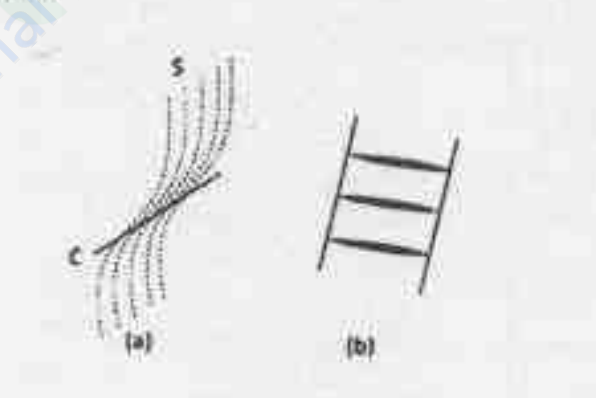
Figures (a) and (b) show S-C structure and en-echelon veins in two different shear zones. Which one of the following options is correct interpretation of sense of shear in figures (a) and (b)?