
Question
Match the structural joining systems in Group I with the corresponding materials for which they are commonly used in Group II. Group I Group II (P) Welding (1) Glass (Q) Spider Connector (2) Plastic (R) Mortise and Tenon (3) Brick (S) Mortar (4) Steel (5) Timber
The correct answer is
P-4, Q-1, R-5, S-3
Matching Structural Joining Systems
This solution focuses on matching structural joining systems from Group I with their corresponding materials in Group II.
Joining System P: Welding
- Welding (P) is a fabrication process that joins materials, usually metals or thermoplastics, by causing coalescence.
- This is commonly achieved by melting the workpieces and adding a filler material to form a pool of molten material that cools to become a strong joint.
- Steel (4) is a primary material extensively joined using welding techniques.
- Thus, P corresponds to 4.
Joining System Q: Spider Connector
- Spider Connectors (Q) are specialized fittings used in modern architectural glazing systems.
- They are designed to connect multiple glass panels efficiently and provide structural support.
- These connectors are specifically suited for use with Glass (1) panels in facades and skylights.
- Thus, Q corresponds to 1.
Joining System R: Mortise and Tenon
- Mortise and Tenon (R) is a robust joint historically used in carpentry and woodworking.
- It involves a projecting component (tenon) on one piece fitting snugly into a slot (mortise) on another.
- This classic joint is predominantly employed with Timber (5) to create strong connections in furniture and structures.
- Thus, R corresponds to 5.
Joining System S: Mortar
- Mortar (S) is a workable paste used as a bonding agent in masonry construction.
- It fills the spaces between building units, such as bricks or stones, and solidifies over time, creating a rigid structure.
- Brick (3) is a common masonry unit that is laid and joined using mortar.
- Thus, S corresponds to 3.
Final Matching Summary
The established correspondences are:
- P (Welding) - 4 (Steel)
- Q (Spider Connector) - 1 (Glass)
- R (Mortise and Tenon) - 5 (Timber)
- S (Mortar) - 3 (Brick)
This leads to the match P-4, Q-1, R-5, S-3.
Was this answer helpful?
Important Questions from Building Construction Techniques
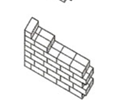
Match the brick masonry bond type in Group I with the corresponding illustration in Group II
Group I Group II (P) Rat Trap (1) 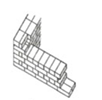
(Q) English (2) 
(R) Flemish (3) 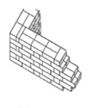
(S) Stretcher (4) 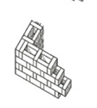
(5) 
- Cold joint' refers to the
- Match the Elements in Group - I with their Applications in Group - II
Group - I Group - II P Bracket 1 Door Q Baluster 2 Dome R Key stone 3 Cornice S Holdfast 4 Arch 5 Staircase - Match the Vibrator Types in Group-I with their related Areas of Application in Group-II
Group-I Group-II P Needle Vibrator 1 Concrete Pavement Q Shutter Vibrator 2 Pre-cast Concrete Unit R Surface Vibrator 3 Beam-Column Junction S Table Vibrator 4 Retaining Wall 5 Slip Forming - Match the type of Temporary Structures in Group - I with their corresponding Functions in Group - II
Group-I Group-II P Scaffolding 1 To support unsafe structure Q Formwork 2 To support platforms for workmen and materials at raised height during construction R Shoring 3 Removal of water from pits S Underpinning 4 Mould for RCC Structure 5 Strengthening the existing foundation
Need Expert Advice?


