
Match the following vertical control characters in FORTRAN with their effects :List – I List – II a. $\not{b}$ (blank) i. Overprint b. 0 (zero) ii. Eject page c. 1 (one) iii. Double space d. + (plus) iv. Single space
a-iv, b-iii, c-ii, d-i
What carriage control is. When a FORTRAN program writes to a line printer, the first character of every output record is not printed. It is stripped off and interpreted as a vertical-spacing command telling the printer how to advance the paper before the rest of the line is printed. Only four characters are defined:
| First character | Action before printing | Match |
|---|---|---|
| blank | advance one line — single space | iv |
| 0 (zero) | advance two lines — double space | iii |
| 1 (one) | advance to top of next page — eject page | ii |
| + (plus) | do not advance — overprint the previous line | i |
Read off the matching. a → iv, b → iii, c → ii, d → i, which is option 4. Notice the answer is simply the reversal of the list order, a pattern that is easy to check once the four effects are known.
Mnemonics that make each one obvious. A blank asks for nothing special, so it gives ordinary single spacing — the default. Zero is "one extra blank line", hence double spacing. One means "page one" or "start a new page", hence the eject. The plus sign means "add to what is already there", hence overprinting on the same line.
Why overprint existed. On an impact line printer, striking the same line twice was the only way to produce bold text, to underline (print the text, then overprint a line of underscores), or to superimpose plotting characters to build crude graphs. The technique disappeared with the arrival of laser printers.
The practical hazard. Because the first character is always consumed, forgetting to supply one silently swallows the first character of real data — and a numeric field beginning with '1' will unexpectedly throw a new page. Careful FORTRAN code therefore always begins a print format with an explicit 1X or a literal blank.
Hence, the correct matching is a-iv, b-iii, c-ii, d-i.
Similar Questions
The function "isalnum( )" returns a non-zero value if the character is alphanumeric and zero otherwise. What is header file to be used in the main program ?
To read a integer variable, find the correct format given below :
Int m;
Find the correct list, which is the reverse (at all levels) of the given list :
[[4, 7, 8], 2, 9, [19, 6], 20, 3]
(i) 3, 20
(ii) 9, 2
(iii) [6, 19]
(iv) [8, 7, 4]Which of the following is not an infinite loop ?
(A) int i = 1;
while (1)
{
i++ ;
}
(B) for ( ; ; ) ;
(C) int t = 0, f ;while (t)
{
f = 1;
}
(D) int y, x = 0 ;
do
{
y = x;
}
while (x == 0);
The three types of loops available in C language are
i. for
ii. while
iii. do-whileWhich loops do not operate without testing the condition even once ?
Match the following :
List – I List – II a. associativity i. memory storage b. # define ii. if-then-else c. auto iii. operators with equal precedence d. conditional operator iv. define operator Codes :
Assertion (A) : 'C' uses many data types such as integers (short and long) and float etc.
Reason (R) : Conversion specifier used for short unsigned integer is % lu.
Which bitwise operator is suitable for turning off a particular bit in a number ?
Which storage class is used for the variables that are often required in a program ?
Which is not a proper way of array declaration ?
Important Questions from Miscellaneous
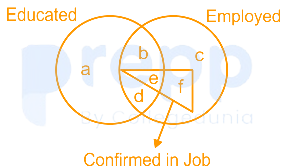
Read the given figure and find the region representing persons who are educated and employed but not confirmed in job.
The magazine in which Mahatma Gandhi mentioned what he wanted the Constitution to do is:
Which gas shields the surface of the earth from ultraviolet radiation from the sun?
Which event is marked as an Intangible Cultural Heritage of Humanity by UNESCO?
Who has been conferred with the rank of the Commander of the Order of the British Empire in 2018?



