
In thermodynamic processes, which of the following statements is not true?
In an isobaric process, the volume remains constant
Each named thermodynamic process is defined by the quantity it keeps fixed or by the heat exchange it allows. Checking every statement against these definitions picks out the one that is false.
Step 1 — Isothermal: the temperature is held constant, so the first statement is true.
Step 2 — Isobaric: it is the pressure that is held constant; the volume changes with temperature (for an ideal gas V/T stays constant). The statement that the volume remains constant describes an isochoric process, so it is not true.
Step 3 — Adiabatic: no heat is exchanged, which is achieved by insulating the system from the surroundings, so that statement is true.
Step 4 — For a reversible adiabatic change of an ideal gas, \(PV^{\gamma}\) remains constant, so the last statement is also true.
Since the isothermal, insulation and adiabatic-relation statements all match their definitions, the only incorrect description is the one given for the isobaric process.
In an isobaric process, the volume remains constant option is correct.
Similar Questions
At 27°C temperature, the mean kinetic energy of the atoms of an ideal gas is E1. If the temperature is increased to 327°C , then the mean kinetic energy of the atoms will be
A gas is taken from state A to state B along two different paths 1 and 2. The heat absorbed and work done by the system along these two paths are Q1 and Q2 and W1 and W2 respectively. Then
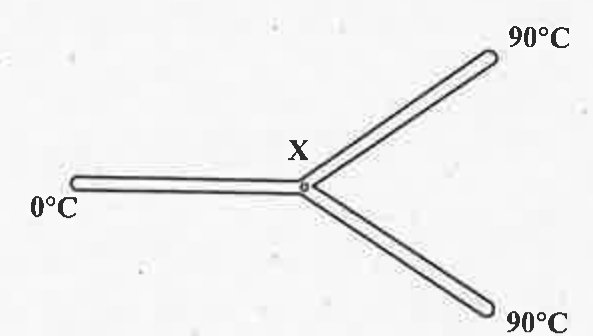
Three metal rods of the same material and identical in all respects are joined as shown in the figure. The temperatures at the ends of these rods are maintained as indicated. Assuming no heat energy loss occurs through the curved surfaces of the rods, the temperature at the junction x is
The graph of pressure P and volume V of 1 mole of an ideal gas at constant temperature is
Following are statements of a few processes taking place in nature.
I. Free expansion of a gas
II. The combustion of a mixture of petrol and air ignited by a spark
III. The leaking of gas from the kitchen cylinder
IV. The transfer of heat from one heated part of a liquid to the other colder part
Which amongst these processes are irreversible in nature?
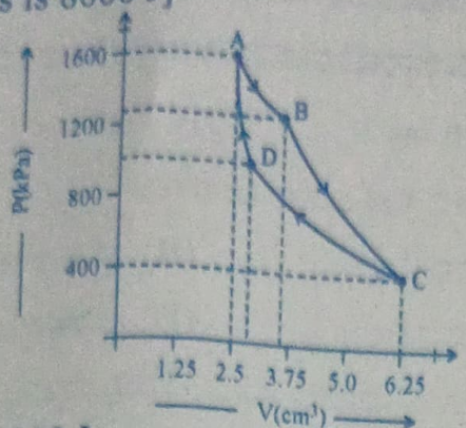
The P-V diagram of a Carnot’s engine is shown in the graph below. The engine uses 1 mole of an ideal gas as working substance. From the graph, the area enclosed by the P-V diagram is [The heat supplied to the gas is 8000 J]
A pan filled with hot food cools from 94 °C to 86 °C in 2 minutes. When the room temperature is 20 °C. How long will it cool from 74 °C to 66 °C ?
Four rods with different radii \(r\) and length \(l\) are used to connect two heat reservoirs at different temperature. Which one will conduct most heat ?
A Carnot engine working between 300 K and 400 K has 800 J of useful work. The amount of heat energy supplied to the engine from the source is
100 g of ice at 0 °C is mixed with 100 g of water at 100 °C. The final temperature of the mixture is
[Take \(L_f=3.36\times10^5\ \text{J kg}^{-1}\) and \(S_w=4.2\times10^3\ \text{J kg}^{-1}\text{k}^{-1}\)]
Important Questions from Heat and Thermodynamics
- When $300 \text{ J}$ of heat given to an ideal gas with $C_p = \frac{7}{2} R$ its temperature raises from $20^\circ\text{C}$ to $50^\circ\text{C}$ keeping its volume constant. The mass of the gas is (approximately) _______ g. ($R = 8.314 \text{ J/mol.K}$)
- Two cylindrical rods A and B made of different materials, are joined in a straight line. The ratios of lengths, radii and thermal conductivites of these rods are: $\frac{L_A}{L_B} = 1$, $\frac{r_A}{r_B} = 2$ and $\frac{K_A}{K_B} = \frac{1}{2}$. The free ends of rods A and B are maintained at 400 K, 200 K, respectively. The temperature of rods interface is ________ K, when equilibrium is established.
The internal energy of air in $4 m \times 4 m \times 3 m$ sized room at 1 atmospheric pressure will be ________ $\times 10^6$ J.
(Consider air as diatomic molecule)At 27°C temperature, the mean kinetic energy of the atoms of an ideal gas is E1. If the temperature is increased to 327°C , then the mean kinetic energy of the atoms will be
A gas is taken from state A to state B along two different paths 1 and 2. The heat absorbed and work done by the system along these two paths are Q1 and Q2 and W1 and W2 respectively. Then


