
To solve this problem, we need to understand the concept of resonance in air columns that are closed at one end. In a closed pipe, the fundamental frequency of vibration is determined by the formula:
f = \frac{v}{4L}
where f is the frequency, v is the velocity of sound, and L is the length of the air column.
Let's denote L_1 = 100 \text{ cm} = 1 \text{ m} and L_2 = 120 \text{ cm} = 1.2 \text{ m}. The frequencies of these two columns in their fundamental modes are:
f_1 = \frac{v}{4 \times 1} = \frac{v}{4}
f_2 = \frac{v}{4 \times 1.2} = \frac{v}{4.8}
The problem states that these two frequencies produce 15 beats per second:
|f_1 - f_2| = 15
Substitute the expressions for f_1 and f_2:
\left|\frac{v}{4} - \frac{v}{4.8}\right| = 15
Calculate the difference inside the absolute value:
\frac{v}{4} - \frac{v}{4.8} = \frac{v \cdot 4.8 - v \cdot 4}{4 \cdot 4.8}
\frac{v(4.8 - 4)}{19.2} = \frac{0.8v}{19.2} = \frac{v}{24}
Therefore, the equation becomes:
\frac{v}{24} = 15 \quad \Rightarrow \quad v = 15 \times 24 = 360 \text{ m/s}
Thus, the velocity of sound in the air column is 360 m/s.
The correct answer is 360 \text{ m/s}.
Similar Questions
- Two tuning forks $A$ and $B$ are sounded together giving rise to $8$ beats in $2\text{ s}$. When fork $A$ is loaded with wax, the beat frequency is reduced to $4$ beats in $2\text{ s}$. If the original frequency of tuning fork $B$ is $380\text{ Hz}$ then original frequency of tuning fork $A$ is _________ $\text{Hz}$.
- 5 beats/second are heard when a turning fork is sounded with a sonometer wire under tension, when the length of the sonometer wire is either 0.95 m or 1 m. The frequency of the fork will be
- A sinusoidal wave of wavelength 7.5 cm travels a distance of 1.2 cm along the x-direction in 0.3 sec. The crest P is at x=0 at t=0 sec and maximum displacement of the wave is 2 cm. Which equation correctly represents this wave ?
A particle is subjected to two simple harmonic motions as :
$x_1 = \sqrt{7} \sin 5t \text{ cm}$ and $x_2 = 2\sqrt{7} \sin \left(5t + \frac{\pi}{3}\right) \text{ cm}$
where x is displacement and t is time in seconds. The maximum acceleration of the particle is $x \times 10^{-2} \text{ ms}^{-2}$. The value of x is :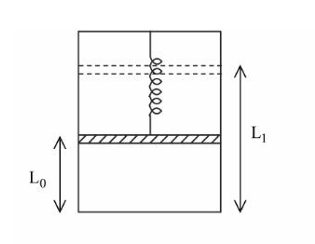
A piston of mass $M$ is hung from a massless spring whose restoring force law goes as $F= -kx^3$, where $k$ is the spring constant of appropriate dimension. The piston separates the vertical chamber into two parts, where the bottom part is filled with 'n' moles of an ideal gas. An external work is done on the gas isothermally (at a constant temperature $T$) with the help of a heating filament (with negligible volume) mounted in lower part of the chamber, so that the piston goes up from a height $L_0$ to $L_1$, the total energy delivered by the filament is : (Assume spring to be in its natural length before heating)
- The velocity of sound in air is doubled when the temperature is raised from $0^\circ\text{C}$ to $\alpha^\circ\text{C}$. The value of $\alpha$ is ________.
- A cylindrical block of mass $M$ and area of cross section $A$ is floating in a liquid of density $\rho$ and with its axis vertical. When depressed a little and released the block starts oscillating. The period of oscillation is ______.
- The velocity of a particle executing simple harmonic motion along $x$-axis is described as $v^2 = 50 - x^2$, where $x$ represents displacement. If the time period of motion is $\frac{x}{7}~\text{s}$, the value of $x$ is ________.
Two simple harmonic motions, as shown below, are at right angles. They are combined to form lissajous figures.
$x(t) = A \sin (at + \delta)$
$y(t) = B \sin (bt)$
Identify the correct match below :
The motion of a mass on a spring, with spring constant K is as shown in figure.
The equation of motion is given by $x(t) = A\sin\omega t+B\cos\omega t$ with $\omega=\sqrt{\frac{K}{m}}$.
Suppose that at time $t = 0$, the position of mass is $x(0)$ and velocity $v(0)$, then its displacement can also be represented as $x(t) = C\cos(\omega t-\phi)$, where $C$ and $\phi$ are
Important Questions from Oscillations and Waves
- Two tuning forks $A$ and $B$ are sounded together giving rise to $8$ beats in $2\text{ s}$. When fork $A$ is loaded with wax, the beat frequency is reduced to $4$ beats in $2\text{ s}$. If the original frequency of tuning fork $B$ is $380\text{ Hz}$ then original frequency of tuning fork $A$ is _________ $\text{Hz}$.
- 5 beats/second are heard when a turning fork is sounded with a sonometer wire under tension, when the length of the sonometer wire is either 0.95 m or 1 m. The frequency of the fork will be
- A sinusoidal wave of wavelength 7.5 cm travels a distance of 1.2 cm along the x-direction in 0.3 sec. The crest P is at x=0 at t=0 sec and maximum displacement of the wave is 2 cm. Which equation correctly represents this wave ?
A particle is subjected to two simple harmonic motions as :
$x_1 = \sqrt{7} \sin 5t \text{ cm}$ and $x_2 = 2\sqrt{7} \sin \left(5t + \frac{\pi}{3}\right) \text{ cm}$
where x is displacement and t is time in seconds. The maximum acceleration of the particle is $x \times 10^{-2} \text{ ms}^{-2}$. The value of x is :- The equation of a transverse wave is $y = y_0 \sin 2\pi(ft - \frac{x}{\lambda})$. If the maximum particle velocity be four times that of wave velocity then


