
The angle between the particle velocity and wave velocity in a transverse wave is [except when the particle passes through the mean position]
\(\dfrac{\pi}{2}\) radian
In a transverse wave the particles of the medium oscillate perpendicular to the direction in which the wave travels; this is what defines a transverse wave.
Step 1 — The wave velocity points along the direction of propagation, say the x-axis.
Step 2 — Each particle moves only along the y-axis, so its velocity is along +y or −y, perpendicular to the x-axis.
Step 3 — The angle between the two velocities is therefore \(\dfrac{\pi}{2}\) radian whenever the particle is moving.
A zero or π angle would mean motion along the propagation direction, which describes a longitudinal wave; an angle of π/4 has no basis in either kind of wave.
\(\dfrac{\pi}{2}\) radian option is correct.
Similar Questions
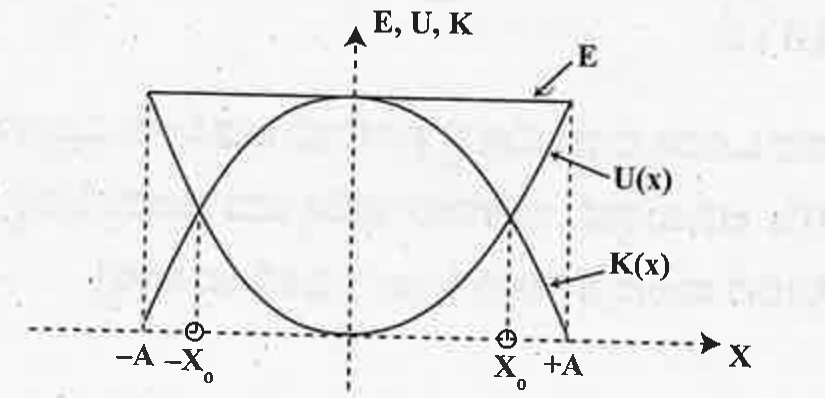
The variations of kinetic energy K(x), potential energy U(x) and total energy as a function of displacement of a particle in SHM is as shown in the figure. The value of |x0| is
A source of frequency ν gives 6 beats/second when sounded with a source of frequency 200 Hz. The second Harmonic of frequency 2 ν of the source gives 8 beats/second when sounded with a source of frequency 420 Hz. The value of ν is
A mass of 1 kg is executing SHM. Its displacement is given by x = 6.0 cos(100t + π/4) cm. What is the maximum kinetic energy?
A particle executing SHM has a maximum speed of \(0.5\ \mathrm{ms^{-1}}\) and maximum acceleration of \(1.0\ \mathrm{ms^{-2}}\). The angular frequency of oscillation is
A source of sound is moving with a velocity of \(50\ \mathrm{ms^{-1}}\) towards a stationary observer. The observer measures the frequency of sound as 500 Hz. The apparent frequency of sound as heard by the observer when source is moving away from him with the same speed is (Speed of sound at room temperature \(350\ \mathrm{ms^{-1}}\))
A block of mass m is connected to a light spring of force constant k. The system is placed inside a damping medium of damping constant b. The instantaneous values of displacement, acceleration and energy of the block are x, a and E respectively. The initial amplitude of oscillation is A and ω' is the angular frequency of oscillations. The incorrect expression related to the damped oscillations is
The speed of sound in an ideal gas at a given temperature T is v. The rms speed of gas molecules at that temperature is \(v_{rms}\). The ratio of the velocities v and \(v_{rms}\) for helium and oxygen gases are X and X' respectively. Then \(\frac{X}{X'}\) is equal to
The waves set up in a closed pipe are
Two simple pendulums A and B are made to oscillate simultaneously and it is found that A completes 10 oscillations in 20 sec and B completes 8 oscillations in 10 sec. The ratio of the lengths of A and B is
A motor-cyclist moving towards a huge cliff with a speed of 18 kmh-1, blows a horn of source frequency 325 Hz. If the speed of the sound in air is 330 ms-1, the number of beats heard by him is
Important Questions from Oscillations and Waves
- Two tuning forks $A$ and $B$ are sounded together giving rise to $8$ beats in $2\text{ s}$. When fork $A$ is loaded with wax, the beat frequency is reduced to $4$ beats in $2\text{ s}$. If the original frequency of tuning fork $B$ is $380\text{ Hz}$ then original frequency of tuning fork $A$ is _________ $\text{Hz}$.
- 5 beats/second are heard when a turning fork is sounded with a sonometer wire under tension, when the length of the sonometer wire is either 0.95 m or 1 m. The frequency of the fork will be
The variations of kinetic energy K(x), potential energy U(x) and total energy as a function of displacement of a particle in SHM is as shown in the figure. The value of |x0| is
A source of frequency ν gives 6 beats/second when sounded with a source of frequency 200 Hz. The second Harmonic of frequency 2 ν of the source gives 8 beats/second when sounded with a source of frequency 420 Hz. The value of ν is
A mass of 1 kg is executing SHM. Its displacement is given by x = 6.0 cos(100t + π/4) cm. What is the maximum kinetic energy?


