
The waves set up in a closed pipe are
Longitudinal and Stationary
Sound in the air column of a pipe is a pressure wave: air particles vibrate back and forth along the direction in which the wave travels, so the waves are longitudinal. Air cannot support transverse waves because it has no rigidity.
In a closed pipe the wave travelling along the air column is reflected at the closed end (and at the open end), and the incident and reflected waves superpose.
This superposition produces a fixed pattern with a node at the closed end and an antinode near the open end; energy is not carried along the pipe, so the waves are stationary (standing), not progressive.
Hence, the answer is Longitudinal and Stationary.
Similar Questions
The angle between the particle velocity and wave velocity in a transverse wave is [except when the particle passes through the mean position]
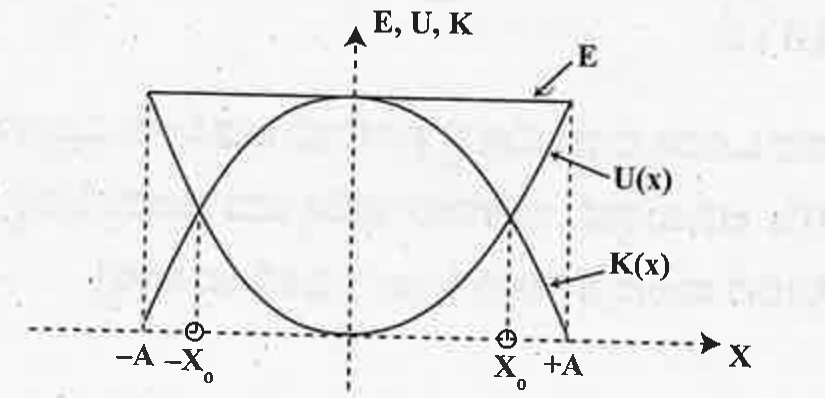
The variations of kinetic energy K(x), potential energy U(x) and total energy as a function of displacement of a particle in SHM is as shown in the figure. The value of |x0| is
A source of frequency ν gives 6 beats/second when sounded with a source of frequency 200 Hz. The second Harmonic of frequency 2 ν of the source gives 8 beats/second when sounded with a source of frequency 420 Hz. The value of ν is
A mass of 1 kg is executing SHM. Its displacement is given by x = 6.0 cos(100t + π/4) cm. What is the maximum kinetic energy?
A particle executing SHM has a maximum speed of \(0.5\ \mathrm{ms^{-1}}\) and maximum acceleration of \(1.0\ \mathrm{ms^{-2}}\). The angular frequency of oscillation is
A source of sound is moving with a velocity of \(50\ \mathrm{ms^{-1}}\) towards a stationary observer. The observer measures the frequency of sound as 500 Hz. The apparent frequency of sound as heard by the observer when source is moving away from him with the same speed is (Speed of sound at room temperature \(350\ \mathrm{ms^{-1}}\))
A block of mass m is connected to a light spring of force constant k. The system is placed inside a damping medium of damping constant b. The instantaneous values of displacement, acceleration and energy of the block are x, a and E respectively. The initial amplitude of oscillation is A and ω' is the angular frequency of oscillations. The incorrect expression related to the damped oscillations is
The speed of sound in an ideal gas at a given temperature T is v. The rms speed of gas molecules at that temperature is \(v_{rms}\). The ratio of the velocities v and \(v_{rms}\) for helium and oxygen gases are X and X' respectively. Then \(\frac{X}{X'}\) is equal to
Two simple pendulums A and B are made to oscillate simultaneously and it is found that A completes 10 oscillations in 20 sec and B completes 8 oscillations in 10 sec. The ratio of the lengths of A and B is
A motor-cyclist moving towards a huge cliff with a speed of 18 kmh-1, blows a horn of source frequency 325 Hz. If the speed of the sound in air is 330 ms-1, the number of beats heard by him is
Important Questions from Oscillations and Waves
- Two tuning forks $A$ and $B$ are sounded together giving rise to $8$ beats in $2\text{ s}$. When fork $A$ is loaded with wax, the beat frequency is reduced to $4$ beats in $2\text{ s}$. If the original frequency of tuning fork $B$ is $380\text{ Hz}$ then original frequency of tuning fork $A$ is _________ $\text{Hz}$.
- 5 beats/second are heard when a turning fork is sounded with a sonometer wire under tension, when the length of the sonometer wire is either 0.95 m or 1 m. The frequency of the fork will be
The angle between the particle velocity and wave velocity in a transverse wave is [except when the particle passes through the mean position]
The variations of kinetic energy K(x), potential energy U(x) and total energy as a function of displacement of a particle in SHM is as shown in the figure. The value of |x0| is
A source of frequency ν gives 6 beats/second when sounded with a source of frequency 200 Hz. The second Harmonic of frequency 2 ν of the source gives 8 beats/second when sounded with a source of frequency 420 Hz. The value of ν is


