
In the question, two statements are given, followed by three conclusions, I, II and III. You have to consider the statements to be true even if they seem to be at variance from commonly known facts. You have to decide which of the given conclusions, if any, follow(s) from the given statements. Statement 1: All bamboo are tall. Statement 2: All tall are grass. Conclusion I: Some grass are bamboo. Conclusion II: Some tall are bamboo. Conclusion III: Some grass are tall.
All conclusions I, II and III follow
Understanding Syllogism Statements and Conclusions
This question asks us to analyze two statements and determine which of the three given conclusions logically follow from these statements. In syllogism problems, we must accept the statements as true, even if they contradict common knowledge.
Analyzing the Syllogism Statements
Let's break down the given statements:
- Statement 1: All bamboo are tall.
- Statement 2: All tall are grass.
From these statements, we can establish a relationship between 'bamboo', 'tall', and 'grass'. If all bamboo belong to the category of 'tall' things, and all 'tall' things belong to the category of 'grass', it means that the category of 'bamboo' is completely contained within the category of 'tall', which is itself completely contained within the category of 'grass'.
Evaluating the Syllogism Conclusions
Now, let's evaluate each conclusion based on the relationship established from the statements:
Conclusion I: Some grass are bamboo.
We know that all bamboo are tall, and all tall are grass. This implies that all bamboo are also grass. If all bamboo are grass, then it is definitely true that some part of the 'grass' category is 'bamboo'. Therefore, this conclusion follows from the statements.
Conclusion II: Some tall are bamboo.
Statement 1 says, "All bamboo are tall." If all members of the 'bamboo' category are also members of the 'tall' category, then it must be true that some members of the 'tall' category are 'bamboo'. This is the converse of an "All A are B" statement ("Some B are A" is a valid inference). Therefore, this conclusion follows from the statements.
Conclusion III: Some grass are tall.
Statement 2 says, "All tall are grass." If all members of the 'tall' category are also members of the 'grass' category, then it must be true that some members of the 'grass' category are 'tall'. This is the converse of an "All B are C" statement ("Some C are B" is a valid inference). Therefore, this conclusion follows from the statements.
Summary of Syllogism Conclusions
Based on our analysis, all three conclusions logically follow from the given statements.
| Statements | Inference |
|---|---|
| All bamboo are tall. | |
| All tall are grass. | |
| ⇒ All bamboo are grass. |
| Conclusion | Analysis | Follows? |
|---|---|---|
| I: Some grass are bamboo. | If All bamboo are grass, then Some grass are bamboo. | Yes |
| II: Some tall are bamboo. | If All bamboo are tall, then Some tall are bamboo. | Yes |
| III: Some grass are tall. | If All tall are grass, then Some grass are tall. | Yes |
Since conclusions I, II, and III all follow from the given statements, the correct option is the one stating that all three conclusions follow.
Revision Table: Key Syllogism Rules
Understanding basic rules helps solve syllogism problems quickly.
- If "All A are B" is true, then "Some B are A" is also true (Converse).
- If "All A are B" and "All B are C" are true, then "All A are C" is true.
- If "All A are B" is true, then "Some A are B" is also true.
- If "Some A are B" is true, the converse "Some B are A" is also true.
Additional Information: Deductive Logic
Syllogisms are a form of deductive reasoning. Deductive reasoning starts with general statements (premises or statements) and reaches a specific conclusion. If the premises are true and the logic is valid, the conclusion must also be true. In this syllogism, the statements provide the general rules about the categories 'bamboo', 'tall', and 'grass', and we deduce specific relationships based on those rules.
Similar Questions
Which of the following diagrams represent the relationship between Male, Husband and Model.
Which of the following Venn diagrams best represents the relationship between Indians, doctors and women?
Which of the following Venn diagrams best represents the relationship between women, mother, and doctor?
Select the correct set that represent the following Venn diagram.

- Select the Venn diagram that best illustrates the relationship between the following classes.
Headgears, Helmets, Caps - Which of the following Venn diagrams best represents the relationship between squares, quadrilaterals and geometrical figures?
Select the most suitable Venn diagram to represent the following relationship.
India, Maharashtra and KeralaWhich of the following Venn diagrams correctly represents the following classes:
Men, Father, Doctor
In the following Venn diagram which region represents the coach who is also a player but not a girl?
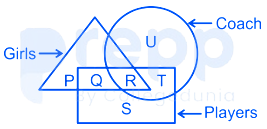
Which of the following Venn diagrams correctly represents the following classes:
Karnataka, India, Asia
Important Questions from Logical Venn Diagram
Select the Venn diagram that best illustrates the relationship among the following classes.
Neptune, Planet, Moon
Select the Venn diagram that best represents the relationship between the following.
India, Delhi, Assam, Guwahati
Select the set of classes, the relationship among which is best illustrated by the following Venn diagram.

Teacher, College, Student –
Cabinet, Home Minister, Minister –



