
In the following simplified diagram of at plant cell, five parts / organelles are marked from 1 to 5: Which one of the following correctly represents the above parts / organelles? 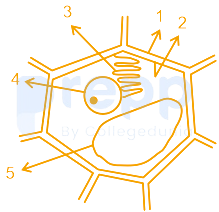
1 - cell wall; 2 - cell membrane; 3 - endoplasmic reticulum; 4 - nucleus; 5 - vacuole
Analyzing the Simplified Plant Cell Diagram
The question asks us to identify five labeled parts/organelles in a simplified diagram of a plant cell. We need to carefully examine the diagram and match the labels (1 to 5) to the correct cell structures.
Identifying the Labeled Parts
Let's look at each labeled part in the provided plant cell diagram:
- Label 1: This label points to the outermost layer of the plant cell. Plant cells have a rigid outer layer outside the cell membrane. This structure is the cell wall.
- Label 2: This label points to the layer just inside the outermost layer (labeled 1). This is the boundary that encloses the cytoplasm in all cells, including plant cells. This structure is the cell membrane.
- Label 3: This label points to a network of membranes within the cytoplasm. This network is involved in protein and lipid synthesis and transport. This structure is the endoplasmic reticulum.
- Label 4: This label points to a prominent, typically spherical or oval organelle within the cytoplasm. It contains the cell's genetic material and controls cell activities. This structure is the nucleus.
- Label 5: This label points to a very large, central space within the plant cell, often occupying a significant portion of the cell volume. This structure is the vacuole, specifically the large central vacuole found in mature plant cells.
Summary of Identifications
Based on our analysis of the diagram, we can summarize the labeled parts as follows:
| Label Number | Identified Structure / Organelle |
|---|---|
| 1 | Cell wall |
| 2 | Cell membrane |
| 3 | Endoplasmic reticulum |
| 4 | Nucleus |
| 5 | Vacuole |
Comparing with Options
Now, let's compare our findings with the given options:
- Option 1: 1 - cell membrane; 2 - cell wall; ... This is incorrect because 1 is the cell wall, and 2 is the cell membrane.
- Option 2: 1 - cell wall; 2 - cell membrane; 3 - endoplasmic reticulum; 4 - vacuole; 5 - nucleus. This is incorrect because 4 is the nucleus, and 5 is the vacuole.
- Option 3: 1 - cell wall; 2 - cell membrane; 3 - endoplasmic reticulum; 4 - nucleus; 5 - vacuole. This option perfectly matches our identification of all five labeled parts.
- Option 4: 1 - cell wall; 2 - cell membrane; 3 - vacuole; ... This is incorrect because 3 is the endoplasmic reticulum, not the vacuole.
Therefore, Option 3 correctly represents the labeled parts of the plant cell diagram.
Revision Table: Key Plant Cell Parts
| Part / Organelle | Location / Appearance in Diagram | Primary Function |
|---|---|---|
| Cell Wall (1) | Outermost rigid layer | Provides structural support and protection |
| Cell Membrane (2) | Just inside the cell wall | Controls passage of substances in/out of the cell |
| Endoplasmic Reticulum (3) | Network of membranes in cytoplasm | Synthesis and transport of proteins and lipids |
| Nucleus (4) | Prominent, often central or peripheral organelle | Contains genetic material, controls cell activities |
| Vacuole (5) | Large central sac | Storage of water, nutrients, waste; maintains turgor pressure |
Additional Information on Plant Cell Organelles
Plant cells have several key organelles that perform specific functions necessary for the cell's survival and the plant's growth. Understanding these parts is crucial for biology students.
- Cell Wall: Unique to plant cells (and some other organisms like fungi and bacteria, but with different composition), it's mainly composed of cellulose. It gives the plant cell its shape and prevents excessive water uptake.
- Cell Membrane: Found in all cells, it's a selectively permeable barrier made of a lipid bilayer with embedded proteins. It regulates the movement of substances.
- Cytoplasm: The jelly-like substance filling the cell, surrounding the organelles. Many metabolic reactions occur here.
- Nucleus: Contains the chromosomes (DNA) and the nucleolus. It is the control center of the cell.
- Endoplasmic Reticulum (ER): A network of interconnected membranes. Rough ER has ribosomes and is involved in protein synthesis and modification. Smooth ER lacks ribosomes and is involved in lipid synthesis and detoxification.
- Golgi Apparatus (or Golgi complex/body): Modifies, sorts, and packages proteins and lipids for secretion or delivery to other organelles. (Not labeled in this simplified diagram).
- Mitochondria: Responsible for cellular respiration, generating energy (ATP). Known as the "powerhouses" of the cell. (Not labeled).
- Chloroplasts: Unique to plant cells (and algae), these organelles carry out photosynthesis, converting light energy into chemical energy (sugars). Contain chlorophyll. (Not labeled).
- Vacuole: Plant cells typically have a large central vacuole that stores water, ions, nutrients, and waste products. It helps maintain turgor pressure against the cell wall, which is essential for plant rigidity.
Similar Questions
Polynucleotide chain of DNA contains
Cell wall isnotpresent in cells of _______
The process of copying genetic information from one strand of DNA into RNA is termed as
Which one of the following is a feature of Membrane?
Which one of the following statements about starch and glycogen is correct?
Which one of the following statements about variations is not true ?
In ovules of Angiosperms, which one of the following is not a haploid cell?
Which one of the following is the correct combination of organelles and their functions?
In plant cells
In plant cells, RNA is present in
Important Questions from Cell
Which of the following is an epithelial tissue?
I. Squamous
II. Ciliated
Cells of ______ and ______ tissues are living cells.
The process of converting ammonia into nitrates is called:
Which of the following is not true about prokaryotic cells?
Fore limbs of whale, bat, tiger and man are examples of



