In the following figure, $\angle A = \angle P$ and AC = PR. Which of the following options needs to be satisfied for Δ PQR and Δ ABC to be congruent?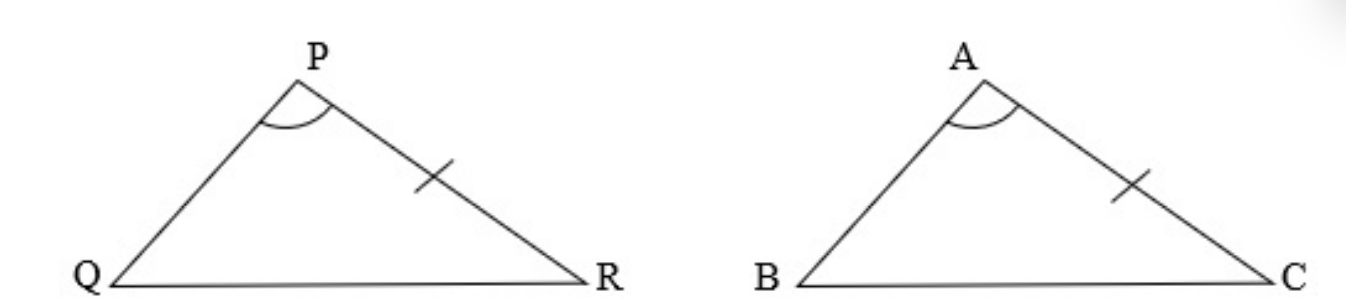
To determine the condition for the congruence of triangles \( \Delta PQR \) and \( \Delta ABC \), we need to analyze the given information:
- \(\angle A = \angle P\)
- \(AC = PR\)
We are required to find which additional condition is needed for congruence.
The congruence criteria involved are:
- SAS (Side-Angle-Side): Two sides and the included angle are equal.
- ASS/SSA: Generally not valid for proving congruence except in the specific case of right triangles (HL).
Given that \(\angle A = \angle P\) and \(AC = PR\), if we have \(AB = PQ\), then we can use the SAS congruence criterion since we have two sides and the included angle equal.
Hence, the condition AB = PQ by SAS criteria must be satisfied for \(\Delta PQR\) and \(\Delta ABC\) to be congruent.
Let's analyze why other options don't work:
- BC = QR by ASS criteria: ASS is not a valid criterion for congruence.
- BC = QR by SSA criteria: Same as above; SSA does not prove congruence.
- AB = PQ by SSA criteria: Again, SSA is not a valid rule for congruence.
Thus, the correct answer is: AB = PQ by SAS criteria.
Important Questions from Triangles, Congruence and Similarity
G is the centroid of the equilateral triangle ABC. If AB = 8√ 3 cm, then the length of AG is equal to:
If sides of a triangle are 12 cm, 15 cm and 21 cm, then what is the inradius (in cm) of the triangle?
What is the area of quadrilateral ABCD?
It is given that ΔABC ~ ΔXYZ and Area ΔABC : Area ΔXYZ = 81 : 25. If AB = 18 cm, BC = 10 cm, CA = 15 cm, then what is the side XZ (in cm)?
Sides of two similar triangles are in the ratio 4 ∶ 9. Area of these triangles are in the ratio: