In case of vertical circular motion of a particle by a thread of length $r$ if the tension in the thread is zero at an angle $30^\circ$ shown in figure, the velocity at the bottom point ($A$) of the circular path is
($g = \text{gravitational acceleration}$)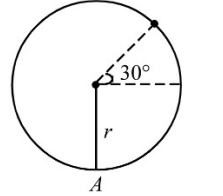
To solve this problem, we need to determine the velocity of a particle at the bottom point \(A\) in a vertical circular motion given that the tension is zero at a \(30^\circ\) angle. Here's how we approach it step-by-step:
- Understand the Conditions:
- The tension in the string becomes zero when centrifugal force equals the gravitational component along the circle.
- This occurs when the particle's speed \(v\) is such that the gravitational force component provides the entire centripetal force.
- Use Energy Conservation:
- The mechanical energy at \(30^\circ\) is the same as at the bottom (point \(A\)).
- Potential energy at \(30^\circ\) can be calculated with \(h = r(1 - \cos(30^\circ))\).
- Kinetic energy at \(30^\circ\) comes into play to balance the potential energy difference at the bottom.
- Calculate Potential Energy at \(30^\circ\): \(h = r \left(1 - \frac{\sqrt{3}}{2}\right)\).
- Apply Conservation of Energy:
- The total energy at \(30^\circ\) equals the kinetic energy at the bottom \(A\).
- Use the equation: \(\frac{1}{2}mv^2 = mgh + \frac{1}{2}mv_0^2\), where \(v_0\) is velocity at \(30^\circ\).
- Tension zero means \(v_0^2 = rg\cos(30^\circ)\).
- Input these into the equation to solve for \(v\) at the bottom.
- Mathematical Calculation:
- Plug in values: \(h = r\left(1 - \frac{\sqrt{3}}{2}\right)\), \(v_0^2 = \frac{rg}{2}\).
- Solve the conservation energy equation for \(v\):
- Derive Required Velocity:
- After simplifying, we reach: \(v^2 = 5gr\).
- The velocity at the bottom is: \(v = \sqrt{5gr}\).
- Conclusion:
- The correct answer is \(\sqrt{5gr}\)
- This matches the given correct option. Ensures the calculation follows the problem constraints.
Similar Questions
- When a part of a straight capillary tube is placed vertically in a liquid, the liquid raises upto certain height h. If the inner radius of the capillary tube, density of the liquid and surface tension of the liquid decrease by 1% each, then the height of the liquid in the tube will change by _________ %.
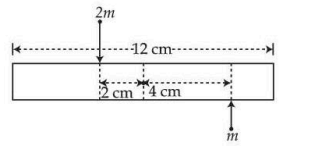
A uniform bar of length 12 cm and mass $20m$ lies on a smooth horizontal table. Two point masses $m$ and $2m$ are moving in opposite directions with same speed of $v$ and in the same plane as the bar, as shown in figure. These masses strike the bar simultaneously and get stuck to it. After collision the entire system is rotating with angular frequency $\omega$. The ratio of $v$ and $\omega$ is :
- Two masses $m$ and $2m$ are connected by a light string going over a pulley (disc) of mass $30m$ with radius $r=0.1 \text{ m}$. The pulley is mounted in a vertical plane and it is free to rotate about its axis. The $2m$ mass is released from rest and its speed when it has descended through a height of 3.6 m is _________ m/s. (Assume string does not slip and $g = 10 \text{ m/s}^2$)
- A spring of force constant 15 N/m is cut into two pieces. If the ratio of their length is 1:3, then the force constant of smaller piece is ______ N/m.
Match the LIST-I with LIST-II
List-I: List-II: A. Magnetic induction I. $[M L T^{-2} A^{-2}]$ B. Magnetic flux II. $[M L^2 T^{-2} A^{-2}]$ C. Magnetic permeability III. $[M L^0 T^{-2} A^{-1}]$ D. Self inductance IV. $[M L^2 T^{-2} A^{-1}]$ Choose the correct answer from the options given below:
- Two masses 400 g and 350 g are suspended from the ends of a light string passing over a heavy pulley of radius 2 cm. When released from rest the heavier mass is observed to fall 81 cm in 9 s. The rotational inertia of the pulley is ______ $\text{kg.m}^2$. ($g = 9.8 \text{ m/s}^2$)
- Three masses 200 kg, 300 kg and 400 kg are placed at the vertices of an equilateral triangle with sides 20 m. They are rearranged on the vertices of a bigger triangle of side 25 m and with the same centre. The work done in this process ______ J.
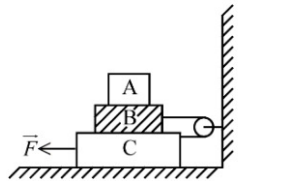
(Gravitational constant $G = 6.7 \times 10^{-11} \text{ N m}^2/\text{kg}^2$) In the given figure the blocks $A$, $B$ and $C$ weigh 4 kg, 6 kg and 8 kg respectively. The co-efficient of sliding friction between any two surfaces is 0.5. The force $\vec{F}$ required to slide the block $C$ with constant speed is ______ N. (Use $g = 10 \text{ m/s}^2$)
- The fifth harmonic of a closed organ pipe is found to be in unison with the first harmonic of an open pipe. The ratio of lengths of closed pipe to that of the open pipe is $5/x$. The value of $x$ is _______.
- In a vernier callipers, 50 vernier scale divisions are equal to 48 main scale divisions. If one main scale division $= 0.05 \text{ mm}$, then the least count of the vernier callipers is _______ mm.
Important Questions from Mechanics
- When a part of a straight capillary tube is placed vertically in a liquid, the liquid raises upto certain height h. If the inner radius of the capillary tube, density of the liquid and surface tension of the liquid decrease by 1% each, then the height of the liquid in the tube will change by _________ %.
A uniform bar of length 12 cm and mass $20m$ lies on a smooth horizontal table. Two point masses $m$ and $2m$ are moving in opposite directions with same speed of $v$ and in the same plane as the bar, as shown in figure. These masses strike the bar simultaneously and get stuck to it. After collision the entire system is rotating with angular frequency $\omega$. The ratio of $v$ and $\omega$ is :
- Two masses $m$ and $2m$ are connected by a light string going over a pulley (disc) of mass $30m$ with radius $r=0.1 \text{ m}$. The pulley is mounted in a vertical plane and it is free to rotate about its axis. The $2m$ mass is released from rest and its speed when it has descended through a height of 3.6 m is _________ m/s. (Assume string does not slip and $g = 10 \text{ m/s}^2$)
- A spring of force constant 15 N/m is cut into two pieces. If the ratio of their length is 1:3, then the force constant of smaller piece is ______ N/m.
Match the LIST-I with LIST-II
List-I: List-II: A. Magnetic induction I. $[M L T^{-2} A^{-2}]$ B. Magnetic flux II. $[M L^2 T^{-2} A^{-2}]$ C. Magnetic permeability III. $[M L^0 T^{-2} A^{-1}]$ D. Self inductance IV. $[M L^2 T^{-2} A^{-1}]$ Choose the correct answer from the options given below: