
Spring Force Constant Dynamics
The force constant ($k$) of a spring is inversely proportional to its length ($L$). This fundamental property means that the product of the force constant and length remains constant for segments derived from the same original spring. Mathematically, this is expressed as $k \propto \frac{1}{L}$, or $k \cdot L = \text{constant}$.
Constant Product Principle
When a spring is cut, each resulting piece retains this characteristic. If the original spring has a force constant $k_{orig}$ and length $L$, and it is cut into pieces with lengths $L_1, L_2, \dots$ and corresponding force constants $k_1, k_2, \dots$, then the relationship $k_1 L_1 = k_2 L_2 = \dots = k_{orig} L$ holds true.
Spring Segmentation Ratio
The problem states the spring is cut into two pieces with a length ratio of 1:3. Let the original length of the spring be $L$. The lengths of the two pieces ($L_1$ and $L_2$) are determined as follows:
- The total ratio parts are $1 + 3 = 4$.
- Length of the first piece: $L_1 = \frac{1}{4} L$.
- Length of the second piece: $L_2 = \frac{3}{4} L$.
Calculating Piece Force Constants
The initial force constant of the spring is given as $k_{orig} = 15$ N/m. We can now calculate the force constants ($k_1$ and $k_2$) for the two pieces using the constant product principle ($k \cdot L = \text{constant}$):
- For the piece with length $L_1 = \frac{1}{4} L$: The equation is $k_1 \times L_1 = k_{orig} \times L$. Substituting the values: $k_1 \times (\frac{1}{4} L) = 15 \text{ N/m} \times L$ Solving for $k_1$: $k_1 = 15 \text{ N/m} \times 4 = 60 \text{ N/m}$
- For the piece with length $L_2 = \frac{3}{4} L$: The equation is $k_2 \times L_2 = k_{orig} \times L$. Substituting the values: $k_2 \times (\frac{3}{4} L) = 15 \text{ N/m} \times L$ Solving for $k_2$: $k_2 = 15 \text{ N/m} \times \frac{4}{3} = 20 \text{ N/m}$
Final Force Constant Value
The two pieces have calculated force constants of 60 N/m and 20 N/m. The piece with the smaller length ($L_1 = L/4$) has a force constant of 60 N/m, while the piece with the larger length ($L_2 = 3L/4$) has a force constant of 20 N/m. The question asks for the force constant of the smaller piece.
The calculated force constant is 20 N/m.
Similar Questions
- The escape velocity from a spherical planet A is 10 km/s. The escape velocity from another planet B whose density and radius are 10% of those of planet A, is _________ m/s.
A cylindrical tube AB of length $l$, closed at both ends contains an ideal gas of 1 mol having molecular weight $M$. The tube is rotated in a horizontal plane with constant angular velocity $\omega$ about an axis perpendicular to AB and passing through the edge at end A, as shown in the figure. If $P_A$ and $P_B$ are the pressures at $A$ and $B$ respectively, then
(Consider the temperature is same at all points in the tube)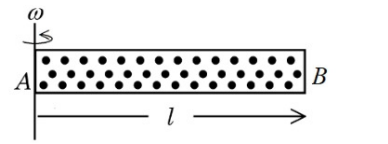
- A solid sphere of mass 5 kg and radius 10 cm is kept in contact with another solid sphere of mass 10 kg and radius 20 cm. The moment of inertia of this pair of spheres about the tangent passing through the point of contact is _________ $\text{kg.m}^2$.
- A circular disc has radius $R_1$ and thickness $T_1$. Another circular disc made of the same material has radius $R_2$ and thickness $T_2$. If the moment of inertia of both discs are same and $\frac{R_1}{R_2} = 2$ then $\frac{T_1}{T_2} = \frac{1}{\alpha}$. The value of $\alpha$ is _________.
- Given below are two statements :
Statement I : A satellite is moving around earth in the orbit very close to the earth surface. The time period of revolution of satellite depends upon the density of earth.
Statement II : The time period of revolution of the satellite is $T = 2\pi \sqrt{\frac{R_e}{g}}$ (for satellite very close to the earth surface), where $R_e$ radius of earth and g acceleration due to gravity.
In the light of the above statements, choose the correct answer from the options given below : - When a part of a straight capillary tube is placed vertically in a liquid, the liquid raises upto certain height h. If the inner radius of the capillary tube, density of the liquid and surface tension of the liquid decrease by 1% each, then the height of the liquid in the tube will change by _________ %.
A uniform bar of length 12 cm and mass $20m$ lies on a smooth horizontal table. Two point masses $m$ and $2m$ are moving in opposite directions with same speed of $v$ and in the same plane as the bar, as shown in figure. These masses strike the bar simultaneously and get stuck to it. After collision the entire system is rotating with angular frequency $\omega$. The ratio of $v$ and $\omega$ is :
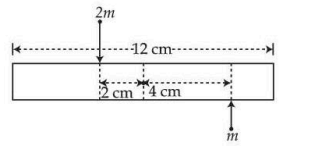
- Two masses $m$ and $2m$ are connected by a light string going over a pulley (disc) of mass $30m$ with radius $r=0.1 \text{ m}$. The pulley is mounted in a vertical plane and it is free to rotate about its axis. The $2m$ mass is released from rest and its speed when it has descended through a height of 3.6 m is _________ m/s. (Assume string does not slip and $g = 10 \text{ m/s}^2$)
Match the LIST-I with LIST-II
List-I: List-II: A. Magnetic induction I. $[M L T^{-2} A^{-2}]$ B. Magnetic flux II. $[M L^2 T^{-2} A^{-2}]$ C. Magnetic permeability III. $[M L^0 T^{-2} A^{-1}]$ D. Self inductance IV. $[M L^2 T^{-2} A^{-1}]$ Choose the correct answer from the options given below:
- Two masses 400 g and 350 g are suspended from the ends of a light string passing over a heavy pulley of radius 2 cm. When released from rest the heavier mass is observed to fall 81 cm in 9 s. The rotational inertia of the pulley is ______ $\text{kg.m}^2$. ($g = 9.8 \text{ m/s}^2$)
Important Questions from Mechanics
- The escape velocity from a spherical planet A is 10 km/s. The escape velocity from another planet B whose density and radius are 10% of those of planet A, is _________ m/s.
A cylindrical tube AB of length $l$, closed at both ends contains an ideal gas of 1 mol having molecular weight $M$. The tube is rotated in a horizontal plane with constant angular velocity $\omega$ about an axis perpendicular to AB and passing through the edge at end A, as shown in the figure. If $P_A$ and $P_B$ are the pressures at $A$ and $B$ respectively, then
(Consider the temperature is same at all points in the tube)- A solid sphere of mass 5 kg and radius 10 cm is kept in contact with another solid sphere of mass 10 kg and radius 20 cm. The moment of inertia of this pair of spheres about the tangent passing through the point of contact is _________ $\text{kg.m}^2$.
- A circular disc has radius $R_1$ and thickness $T_1$. Another circular disc made of the same material has radius $R_2$ and thickness $T_2$. If the moment of inertia of both discs are same and $\frac{R_1}{R_2} = 2$ then $\frac{T_1}{T_2} = \frac{1}{\alpha}$. The value of $\alpha$ is _________.
- Given below are two statements :
Statement I : A satellite is moving around earth in the orbit very close to the earth surface. The time period of revolution of satellite depends upon the density of earth.
Statement II : The time period of revolution of the satellite is $T = 2\pi \sqrt{\frac{R_e}{g}}$ (for satellite very close to the earth surface), where $R_e$ radius of earth and g acceleration due to gravity.
In the light of the above statements, choose the correct answer from the options given below :


