
In a study of interactions between plants, ants and caterpillars, the following experimental treatments were imposed: i) Control (both ants and caterpillars are present); ii) Ant removal; iii) Caterpillar removal; iv) Ant and caterpillar removal. Plus (+) indicates presence and minus (-) indicates absence on plants. The results for plant performance (growth) from this experiment are shown in the figure below. Plant performance in all treatments were significantly different from each other. Based on these results, which of the following inferences is correct?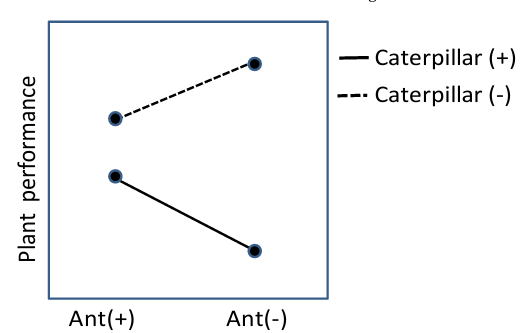
To evaluate the interactions and their impact on plant performance, we need to analyze the experimental conditions described:
- Control (Ants and Caterpillars present): This setup serves as the baseline for comparing the influence of removing either organism.
- Ant removal: Here, caterpillars are present, but ants are absent. Observing plant performance in this condition reveals how caterpillars affect plants without the influence of ants.
- Caterpillar removal: In this scenario, ants are present, but caterpillars are absent. The plant's condition here shows the effect of ants alone.
- Ant and Caterpillar removal: This condition helps isolate the plants to assess growth without any insect interaction.
From the graph, we observe:
- With ants present and caterpillars absent, plant performance decreases compared to the control.
- With caterpillars present and ants absent, plant performance increases compared to ants being present.
These observations lead to the following reasoning:
- When only ants are present, the negative impact on plant performance suggests that ants might harm or stress the plants, perhaps by consuming plant sap or interfering with plant resources.
- When caterpillars are present and ants are removed, plant performance increases, suggesting that the presence of caterpillars may indirectly benefit the plants, perhaps due to a decrease in competition for resources or the absence of predation effects by ants.
Based on this analysis, the correct inference is:
In the absence of caterpillars, ants negatively affected plant performance.
Important Questions from Community interactions
- A native species of butterfly at one site in North America used to feed on plant species P. In the 1960s, an exotic plant species Q was introduced at this site. The butterfly switched to feeding on Q, so much so that it was no longer found feeding on P. When the plant species Q was removed from the site in the 1990s, the butterfly species went locally extinct. Later, a population of the same butterfly species from elsewhere, that still fed on plant P, came and occupied the same site. Which one or more of the processes listed below has/have occurred here?
- Which one of the following is a result of antagonistic coevolution?
- Observations of algal species showed that their diversity was higher in pools where there were grazing snails compared to pools without snails. Which one of the following statements best explains this result?
- Which one of the following ecological processes best explains the observation thatseedling establishment increases with distance from the parent tree in a forest?
- Depending on soil nutrient availability, which one or more of the following interaction(s) can occur between soil mycorrhizal fungi and plants?


