
Understanding the Seating Arrangement Problem
This problem involves finding the number of ways a specific arrangement can occur. We have a total of 8 seats in a row, and we need to find the number of possible seating arrangements where 3 specific people sit consecutively, meaning they sit right next to each other.
Breaking Down the Problem
To solve this, we can think of the 3 people who need to sit together as a single "block" or unit. This simplifies the problem into arranging this block along with the other available seats.
Step-by-Step Solution
- Forming the block: Consider the 3 people who must sit together as one unit.
- Arranging the units: Now, instead of 8 individual seats and 3 people, we have this 1 block (of 3 people) and the remaining $8 - 3 = 5$ empty seats. This gives us a total of $5 + 1 = 6$ items to arrange in the row.
-
Calculating block and seat arrangements: These 6 items (5 empty seats + 1 block) can be arranged in $6!$ ways.
$6! = 6 \times 5 \times 4 \times 3 \times 2 \times 1 = 720$
-
Arranging people within the block: The 3 people within their block can also switch places among themselves. The number of ways these 3 people can arrange themselves within their block is $3!$.
$3! = 3 \times 2 \times 1 = 6$
-
Calculating the total number of ways: To find the total number of ways the 3 people can sit next to each other in the 8 seats, we multiply the number of ways to arrange the block and seats by the number of ways the people can arrange themselves within the block.
Total Ways = (Ways to arrange the 6 items) $\times$ (Ways to arrange the 3 people internally)
Total Ways = $6! \times 3! = 720 \times 6 = 4320$
Wait, let me re-evaluate.
Let's rethink the arrangement part.
Consider the 8 seats: S1, S2, S3, S4, S5, S6, S7, S8.
The group of 3 people can occupy the following consecutive seats:
- (S1, S2, S3)
- (S2, S3, S4)
- (S3, S4, S5)
- (S4, S5, S6)
- (S5, S6, S7)
- (S6, S7, S8)
There are 6 possible positions for the block of 3 people.
For each of these 6 positions, the 3 people can arrange themselves in $3!$ ways.
Number of internal arrangements for the 3 people = $3! = 3 \times 2 \times 1 = 6$.
Total number of ways = (Number of possible positions for the block) $\times$ (Number of internal arrangements within the block)
Total number of ways = $6 \times 3! = 6 \times 6 = 36$.
Final Calculation
There are 6 possible starting positions for the group of 3 people (seats 1-3, 2-4, 3-5, 4-6, 5-7, 6-8).
Within each of these groups of 3 seats, the 3 people can arrange themselves in $3!$ ways.
Number of ways = (Number of groups of seats) $\times$ (Number of ways to arrange people in the group)
Number of ways = $6 \times 3! = 6 \times 6 = 36$.
Conclusion
Therefore, there are 36 different ways for 3 people to sit next to each other in a row of 8 seats.
Similar Questions
- You have four puzzle books on your shelf, and you decide to arrange them in every possible order, moving one book every 30 seconds. How long will it take to arrange all the books?
- If 6 people are seated at a round table, how many distinct seating arrangements are possible?
- In how many ways can 6 people be seated around a round table?
- A player holds 15 cards of four suits, of which eight are red and seven are black. The number of diamonds is twice the number of spades, and the number of hearts is equal to the number of diamonds. How many clubs does he hold?
- If 3 men and 2 women are seated in a row, how many seating arrangements are possible such that no woman is seated next to
another woman? - How many ways can 4 people be seated in a circle if two people must sit next to each other?
- In a row of 8 seats, how many ways can 3 people sit next to each other?
- In how many ways can 5 people be seated in a row such that A and B are not next to each other?
Important Questions from Permutation and Combination
The following figure is made with nine squares of length 1 cm each.
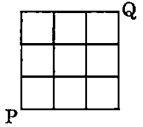
A student is standing at point P. The total number of shortest paths to reach point Q from point P, if the student walks along the boundaries of the squares only, is:
Consider the following statements (all the angles are measured in degrees) :
1. If two supplementary angles are $4x + 40$ and $10x$, then $x$ is;
2. The complementary angle of $\frac{4}{5} \times 45$ is :
3. If two complementary angles are in the ratio of $4 : 5$, then the smallest angle is :
Which of the following is correct?
Codes:
1 2 3- There are 40 persons in a palace. If every person shakes hands with every other person, what will be the total number of handshakes?
- How many words can be formed with or without meaning by using all letters of the word DELHI?
A rectangular wall is divided into four squares of equal size where there are two rows each having two squares. The top left square is coloured with green. If, including green, there are three colours available and each square is coloured using any one of these three colours such that no two adjacent squares get painted with the same colour; then how many colour combinations are possible ?



