In a particular decay process \(^{41}_{20}\text{Ca}\) converts to \(^{41}_{19}\text{K}\) via a beta-decay process. From the given information, conclude which type of decay mode is energetically possible. [Given: \(M(^{41}_{20}\text{Ca}) = 40.962278\) u, \(M(^{41}_{19}\text{K}) = 40.961825\) u, \(M(^{1}_{1}\text{H}) = 1.007825\) u, \(M_n = 1.008665\) u, \(m_e = 0.00055\) u, \(1\ \text{u} = 931.5\ \text{MeV}/c^{2}\).]
Electron capture
Since \(Z\) decreases from 20 to 19, only \(\beta^{+}\) decay or electron capture (EC) can convert \(^{41}\text{Ca}\) into \(^{41}\text{K}\); \(\beta^{-}\) decay is ruled out.
Using atomic masses, \(Q_{EC} = [M(^{41}\text{Ca}) - M(^{41}\text{K})]\,c^{2} = (40.962278 - 40.961825) \times 931.5 = 0.000453 \times 931.5 \approx 0.422\) MeV. Positive, so EC is allowed.
For \(\beta^{+}\): \(Q_{\beta^{+}} = [M(^{41}\text{Ca}) - M(^{41}\text{K}) - 2 m_e]\,c^{2} = (0.000453 - 0.00110) \times 931.5 \approx -0.60\) MeV. Negative, so \(\beta^{+}\) is energetically forbidden.
Hence, only electron capture is energetically possible.
Similar Questions
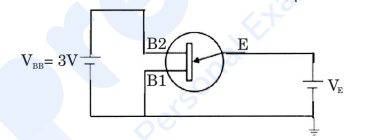
For a given unijunction transistor (UJT) circuit peak voltage (\(V_p\)) is ...........
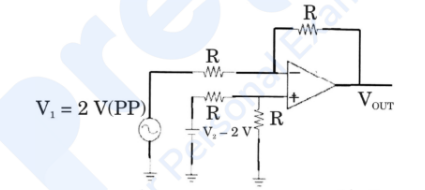
Symbols carry usual meaning.For the operational amplifier circuit shown below, the output waveform \(V_{OUT}(t)\) is:
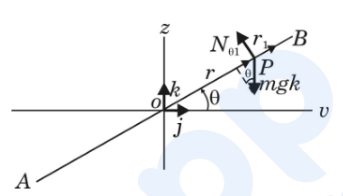
A rod \(AOB\) rotates in a vertical plane (the y-z plane) about a horizontal axis through \(O\) perpendicular to the plane (the x-axis) with constant angular velocity \(\omega\), as shown in the figure below. The equation of motion in \(r\) for a particle \(P\) of mass \(m\) constrained to move along the rod, assuming no frictional forces, is:
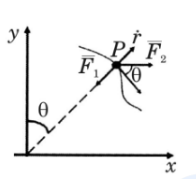
A particle \(P\) of mass \(m\) moves in the XY plane under the action of two forces, as shown in the figure below. \(\vec{F}_1\) is directed from \(P\) toward the fixed origin \(O\); \(\vec{F}_2\) is parallel to the positive x-axis. The angle between the position vector of \(P\) and the positive x-axis is \(\theta\). Using plane polar coordinates \((r,\theta)\) centred at \(O\), the equations of motion of the particle are:
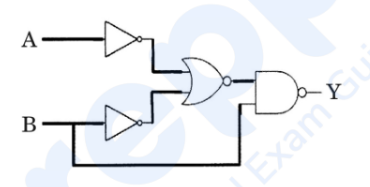
In the logic-gate network shown below, the overall Boolean function realised at output \(Y\) is equivalent to which basic logic gate?
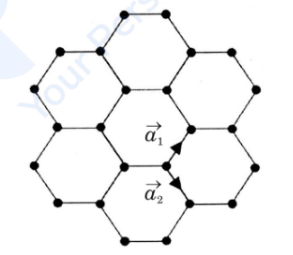
Consider a two-dimensional honeycomb lattice with nearest-neighbour (bond) distance \(a\), as shown in the figure below.
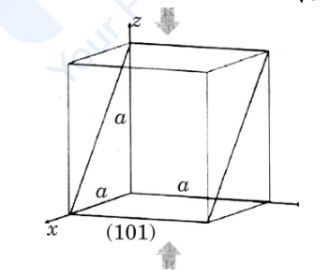
X-rays of wavelength \(\lambda\), when incident on the \((1\,0\,1)\) plane of a cubic lattice with lattice constant \(a\), produce a first-order Bragg reflection at \(\theta = 30^{\circ}\). The unit cell is then compressed along the z-axis so that its x and y edges keep length \(a\) while its z edge shortens to \(a/\sqrt{3}\), as depicted in the figure below.
The value of the line integral \(I = \int \vec{A}\cdot d\vec{r}\), where \(\vec{r} = x\hat{i} + y\hat{j}\) and \(\vec{A} = (x+y)\hat{i} + (y-x)\hat{j}\), along the path \(y^{2} = x\) from the point \((1, 1)\) to the point \((4, 2)\) is:
It is given that the residue of the complex function \(\dfrac{e^{1/z}}{z^{n}}\) at an isolated singular point \(z = 0\) is \(\dfrac{1}{9!}\). The value of \(n\) must be equal to:
A set \(V\) of complex numbers forms a two-dimensional real vector space under the usual addition of complex numbers and multiplication by real numbers. Let \(T : V \to V\) be a linear transformation defined as \(T(z) = \bar{z}\). Eigenvalues of \(T\) are:
Important Questions from Mixed Topic (MH-SET)
Question: How did the Indian mythological film differ from the western biblical film in terms of presentation?
Question: What features distinguished the Indian mythological film from the western biblical film in terms of visual effects?
Question: What significant role does Georges Melies play in the Indian mythological film according to the paragraph?
For a given unijunction transistor (UJT) circuit peak voltage (\(V_p\)) is ...........
Symbols carry usual meaning.For the operational amplifier circuit shown below, the output waveform \(V_{OUT}(t)\) is: