Read the following abridged version of D.G. Phalke and Melies Tradition in Early Indian Cinema by Suresh Chabria (1993) and answer the questions that follow. The staple genre and mainstay of the Indian silent film industry (1913-1931) was the mythological film which is particular to Indian cinema but has some affinities with the biblical or religious epic film of the West. Both these genres deal with the great religious narratives of their respective traditions. However, while the biblical film relies primarily on realistic historical settings and dramatic character portrayal, the Indian mythological film draws directly on the events and imagery of the gods described in the Puranas and epics. The mythological film uses visual effects, colour tinting and trick photography to depict miracles: gods flying through the sky on divine vehicles, demons emerging from flames, avatars appearing to devotees, and heroes wielding celestial weapons that tame storms and seas. Thus while the western biblical film easily crosses over into the historical genre, in the Indian mythological film Georges Melies, the great monstrative genius of the early film form, is ever present like an invisible mentor.
Question: What significant role does Georges Melies play in the Indian mythological film according to the paragraph?
He influenced the use of special effects in Indian mythological films
Georges Melies was a French illusionist and filmmaker whose trick films such as 'A Trip to the Moon' (1902) established the vocabulary of cinematic special effects like stop tricks, dissolves, multiple exposures and hand-painted frames.
Dadasaheb Phalke, considered the father of Indian cinema, studied Melies's techniques during his visits to England and adapted them to stage divine miracles, transformations and celestial imagery in early Indian mythological films.
Melies neither directed Indian films nor acted in them, and mass scenes were not his signature contribution, so the other options are incorrect.
Hence, Georges Melies significantly influenced the use of special effects in Indian mythological films.
Similar Questions
Question: How did the Indian mythological film differ from the western biblical film in terms of presentation?
Question: What features distinguished the Indian mythological film from the western biblical film in terms of visual effects?
Which newspaper in UK was caught in the controversy of hacking phones of celebrities and politicians?
In the context of media studies, what does the term 'representation' mean?
Who among the following theorists say that people play with media like a toy?
Robert Hutchins' Commission report gave rise to which among the following theory?
Which among below is a famous district newspaper of Satara in Maharashtra?
Dr. Babasaheb Ambedkar published Saint Tukaram Maharaj's stanza (Abhang) in which of his newspaper's masthead?
Ajit Balakrishnan built which among the earliest Indian Web Portals?
Which among the following newspaper was first ridiculed as the 'Penny Press'?
Important Questions from Mixed Topic (MH-SET)
Question: How did the Indian mythological film differ from the western biblical film in terms of presentation?
Question: What features distinguished the Indian mythological film from the western biblical film in terms of visual effects?
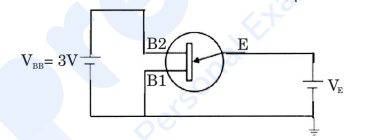
For a given unijunction transistor (UJT) circuit peak voltage (\(V_p\)) is ...........
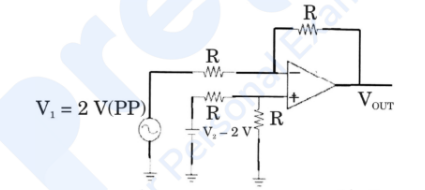
Symbols carry usual meaning.For the operational amplifier circuit shown below, the output waveform \(V_{OUT}(t)\) is:
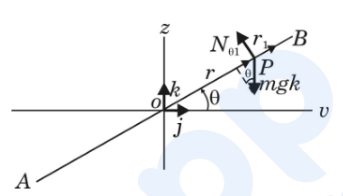
A rod \(AOB\) rotates in a vertical plane (the y-z plane) about a horizontal axis through \(O\) perpendicular to the plane (the x-axis) with constant angular velocity \(\omega\), as shown in the figure below. The equation of motion in \(r\) for a particle \(P\) of mass \(m\) constrained to move along the rod, assuming no frictional forces, is: