Solution Analysis
The problem involves calculating the correction for a specific line in a closed traverse based on a given closing error. A closed traverse ensures that the survey path returns to the starting point. The closing error here is +0.5°, originating from the bearings of the last line, indicating a misclosure in the angle measurements.
- Closing Error: +0.5°
- Number of Sides ($n$): 5
- Line in Question: 4th line ($i=4$)
The total angle misclosure needs to be compensated. The total correction required for the angles is the negative of the closing error.
- Total Correction Required: $-0.5^\circ$
Different methods exist for distributing this correction. Assuming a method where the correction is proportional to the sequence number of the line is required to match the options provided.
Angle Correction Calculation
The correction ($C_i$) for the $i$-th line is calculated proportionally based on its sequence number ($i$) relative to the total number of sides ($n$). The formula used, derived from analyzing the options and the likely intended method, is:
$ C_i = \frac{i}{n} \times (\text{Total Correction Required}) $
For the fourth line ($i=4$) in a five-sided traverse ($n=5$):
$ C_4 = \frac{4}{5} \times (-0.5^\circ) $
$ C_4 = -0.4^\circ $
Convert the correction from decimal degrees to degrees and minutes:
$ -0.4^\circ = -0.4 \times 60 \text{ minutes} = -24 \text{ minutes} $
Thus, the correction for the fourth line is -0°24′.
Important Questions from Traversing
- The forebearing of four sides of a closed quadrilateral ABCDA are
AB = 60°, BC = 149.87°, CD = 269.5°, DA = 20.17°.
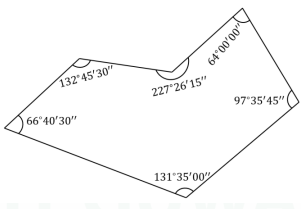
The calculated value of interior angle D is _____° (Answer in decimal degrees and rounded off to two decimal values). The angular misclosure of the closed-loop traverse shown in the figure is _____________ ° (Answer in decimal degrees and rounded off to three decimal places)
- It is needed to establish the coordinates of a station A. Two stations B and C are available whose coordinates are given in the table.
Length of line CA = 1212.38 m; ∠BCA = 64°.
The Easting of station A is _______ m (Rounded off to two decimal places).
Assume station A lies to the west of the traverse line BC.Station Easting (m) Northing (m) B 11054.09 9484.37 C 10827.62 10112.15 - If the departure and latitude of a line are 70 m and -130 m, respectively, then the whole circle bearing of the line in degrees is
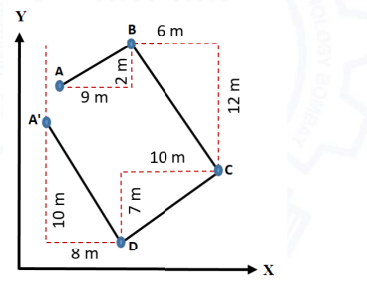
While carrying out a traverse survey ABCDA' using a theodolite with the originating station A, the departures and latitudes of the lines, as obtained, are shown in the following figure (not drawn to scale). It is seen that, due to the observational errors, the originating station A and its computed station A' are not the same. For this survey, the 'closing error' in m is