
In a class of 45 students, all students participate in one or both of the two games, i.e. Chess and Badminton on. 11 students participate in both the games, whereas 17 students participate only in Chess. How many total students participate in Badminton?
28
Understanding the Student Participation Problem
This problem involves determining the number of students who participate in a specific game, Badminton, within a group where all students participate in at least one of two games: Chess or Badminton. We are given information about the total number of students, those who play only Chess, and those who play both games.
Given Information
- Total number of students in the class = 45
- All students participate in either Chess or Badminton or both.
- Number of students who participate in both Chess and Badminton = 11
- Number of students who participate only in Chess = 17
Goal
Find the total number of students who participate in Badminton. This includes students who play only Badminton and students who play both Chess and Badminton.
Applying Set Theory Concepts
We can think of this problem using basic set theory, even without drawing a full Venn diagram. The total number of students is the sum of those who play only Chess, those who play only Badminton, and those who play both.
The relationship can be expressed as:
$\text{Total Students} = (\text{Students only in Chess}) + (\text{Students only in Badminton}) + (\text{Students in both})$
Step-by-Step Calculation
Step 1: Find the number of students who participate only in Badminton.
We know the total students, students only in Chess, and students in both. We can rearrange the formula to find the students only in Badminton:
$\text{Students only in Badminton} = \text{Total Students} - (\text{Students only in Chess}) - (\text{Students in both})$
Plugging in the given values:
$\text{Students only in Badminton} = 45 - 17 - 11$
$\text{Students only in Badminton} = 45 - 28$
$\text{Students only in Badminton} = 17$
So, 17 students participate only in Badminton.
Step 2: Find the total number of students who participate in Badminton.
The total number of students who participate in Badminton includes those who play only Badminton and those who play both Chess and Badminton.
$\text{Total students in Badminton} = (\text{Students only in Badminton}) + (\text{Students in both})$
Using the value calculated in Step 1 and the given value for students in both:
$\text{Total students in Badminton} = 17 + 11$
$\text{Total students in Badminton} = 28$
Therefore, a total of 28 students participate in Badminton.
Summary of Student Participation
| Category | Number of Students |
|---|---|
| Only Chess | 17 |
| Only Badminton | 17 |
| Both Chess and Badminton | 11 |
| Total Students | $\textbf{17 + 17 + 11 = 45}$ |
| Total Badminton Participants | $\textbf{17 (Only Badminton) + 11 (Both) = 28}$ |
| Total Chess Participants | $\textbf{17 (Only Chess) + 11 (Both) = 28}$ |
The total number of students participating in Badminton is 28.
Revision Table: Key Concepts in Set Theory Problems
| Concept | Explanation | Formula (for two sets A and B) |
|---|---|---|
| Union ($A \cup B$) | Elements in set A, or set B, or both. In this problem, this is the total number of students (45), as everyone plays at least one game. | $|A \cup B| = |A| + |B| - |A \cap B|$ |
| Intersection ($A \cap B$) | Elements common to both set A and set B. In this problem, this is the students playing both Chess and Badminton (11). | $|A \cap B|$ |
| Only in A | Elements in set A but not in set B. In this problem, this is students playing only Chess (17). | $|A| - |A \cap B|$ or $|A \cup B| - |B|$ |
| Only in B | Elements in set B but not in set A. In this problem, this is students playing only Badminton (17). | $|B| - |A \cap B|$ or $|A \cup B| - |A|$ |
| Total (when everyone is in A or B or both) | Sum of those only in A, only in B, and in both. | $|A \cup B| = (\text{Only A}) + (\text{Only B}) + (\text{Both})$ |
Additional Information: Solving Participation Problems
Problems like this, involving groups participating in different activities, are common examples of applications of basic set theory principles. While the problem can be solved with simple arithmetic as shown above, visualising it with a Venn diagram can also be very helpful, especially for more complex problems with three or more sets.
- Venn Diagrams: Circles representing each set (Chess, Badminton) overlap. The overlapping region is the intersection (both games). The parts of the circles outside the overlap represent those playing only that specific game. The sum of all distinct regions gives the total number of participants when everyone is included in at least one set.
- Inclusion-Exclusion Principle: The formula $|A \cup B| = |A| + |B| - |A \cap B|$ is known as the Principle of Inclusion-Exclusion. It accounts for the fact that simply adding the total number in Chess ($|A|$) and the total number in Badminton ($|B|$) would count the students playing both ($|A \cap B|$) twice, so you subtract them once. In this problem, we used a simplified version because we were given "only" categories.
Understanding these fundamental concepts helps in solving a wide range of problems involving overlapping groups or categories.
Similar Questions
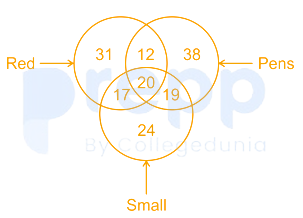
In the given figure, how many red are pens?
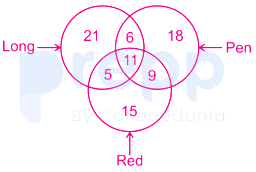
In the given figure, how many long pens are red?
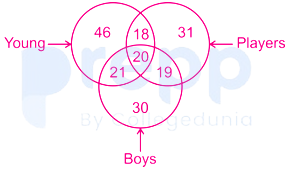
In the figure, how many players are young?
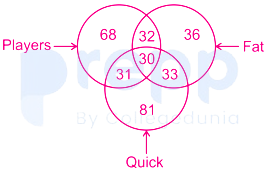
In the given figure, how many players are quick and fat?
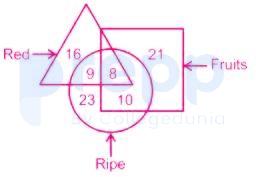
In the given figure, how many red fruits are ripe?
- An office has a total of 95 employees. Each employee participates in one or more of three activities, i.e. music, dance and skit, during the annual festival. The number of employees participating in only music is 20, whereas 14 participate in only skit, and 17 participate in only dance. A total of 8 employees participate in both music and skit only, 12 employees participate in all three activities, and 15 employees participate in both dance and skit only, whereas 9 employees participate in both music and dance only. Find the total number of employees participating in skit?
Study the given diagram carefully and answer the question. The numbers in different sections indicate the number of persons.
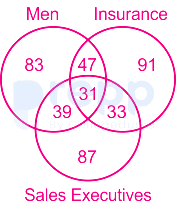
How many man are sales executives in the insurance industry?
- Observe the given Venn diagram and answer the following question.
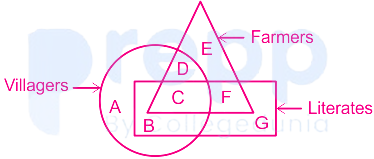
Which section stands for illiterate villagers who are farmers?
In a class of 170 students, 155 students take part in either one or more than one class of either guitar, drum or violin. A total of 21 students take part in any two of the classes. 54 students take part only in drum classes, whereas 43 students take part in violin class only. Only 5 students take part in all the three classes. How many students take part only in guitar classes?
In the following Venn diagram, the pentagon stands for 'girls’, the square stands for ‘mobile phone users’, and the circle stands for ‘toppers’, The given numbers represent the number of persons in that particular category. How many girls are toppers but do NOT use mobile phones?
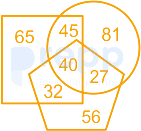
Important Questions from Venn Diagram Problems
In a group of 73 friends, 14 friends go to Gym and Karate classes both, whereas 7 friends neither go to Gym class nor to Karate class. If a total of 36 friends go to Gym class, then how many friends go to only Karate class?
In an examination 20% students failed in Mathematics and 15% failed in English. If 10% failed in both and those who passed in both numbered 300, then the total number of students who appeared in the examination was
In the following diagram, the 'circle' stands for 'soldiers', the 'square' stands for 'Indians', and the 'triangle' stands for 'singers'. The numbers given in the different segments represent persons belonging to that category.
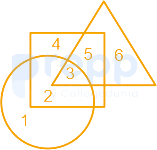
Which category is represented by the number '5'?
- In the following diagram, the circle stands for 'policemen', the square stands for 'sportspersons' and the 'triangle' stands for 'tax-payers' the numbers given in the different segments represent the number of persons in that category.
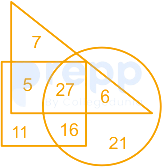
How many policemen are tax-payers but are NOT sportspersons?
The letter that represents the artists who are the doctors and dancers only is



