
In a class of 170 students, 155 students take part in either one or more than one class of either guitar, drum or violin. A total of 21 students take part in any two of the classes. 54 students take part only in drum classes, whereas 43 students take part in violin class only. Only 5 students take part in all the three classes. How many students take part only in guitar classes?
32
Understanding the Student Class Data
This problem involves analyzing the number of students taking different music classes: guitar, drum, and violin. We are given information about the total number of students, the number of students taking at least one class, students taking specific combinations of classes, and students taking only one specific class. Our goal is to find the number of students who take part only in guitar classes.
We can approach this problem using the principles of set theory and Venn diagrams, even without drawing the diagram explicitly. We'll break down the student population into disjoint groups based on the classes they take.
Given Information Breakdown
Let's list the information provided in the question:
- Total number of students in the class = 170
- Number of students taking at least one class (Guitar, Drum, or Violin) = 155
- Number of students taking part in any two of the classes (exactly two) = 21
- Number of students taking part only in drum classes = 54
- Number of students taking part only in violin classes = 43
- Number of students taking part in all three classes = 5
We need to find the number of students who take part only in guitar classes.
Applying Set Theory Logic
The total number of students taking at least one class is the sum of students in all the disjoint regions of the Venn diagram:
- Students taking only Guitar
- Students taking only Drum
- Students taking only Violin
- Students taking Guitar and Drum only
- Students taking Guitar and Violin only
- Students taking Drum and Violin only
- Students taking all three classes (Guitar, Drum, and Violin)
Let:
- \( N(G_{only}) \) = Number of students taking only Guitar classes
- \( N(D_{only}) \) = Number of students taking only Drum classes = 54
- \( N(V_{only}) \) = Number of students taking only Violin classes = 43
- \( N(G \cap D_{only}) \) = Number of students taking Guitar and Drum classes only
- \( N(G \cap V_{only}) \) = Number of students taking Guitar and Violin classes only
- \( N(D \cap V_{only}) \) = Number of students taking Drum and Violin classes only
- \( N(G \cap D \cap V) \) = Number of students taking all three classes = 5
The number of students taking "any two of the classes" refers to those taking exactly two classes. So,
\[ N(G \cap D_{only}) + N(G \cap V_{only}) + N(D \cap V_{only}) = 21 \]
The total number of students taking at least one class is the sum of all these parts:
\[ \text{Total students (at least one class)} = N(G_{only}) + N(D_{only}) + N(V_{only}) + N(G \cap D_{only}) + N(G \cap V_{only}) + N(D \cap V_{only}) + N(G \cap D \cap V) \]
Calculating Students Only in Guitar Classes
Substitute the known values into the equation:
\[ 155 = N(G_{only}) + 54 + 43 + (N(G \cap D_{only}) + N(G \cap V_{only}) + N(D \cap V_{only})) + 5 \]
We know that \( N(G \cap D_{only}) + N(G \cap V_{only}) + N(D \cap V_{only}) = 21 \). Substitute this into the equation:
\[ 155 = N(G_{only}) + 54 + 43 + 21 + 5 \]
Now, sum the known numbers on the right side:
\[ 54 + 43 = 97 \]
\[ 97 + 21 = 118 \]
\[ 118 + 5 = 123 \]
So the equation becomes:
\[ 155 = N(G_{only}) + 123 \]
To find \( N(G_{only}) \), subtract 123 from 155:
\[ N(G_{only}) = 155 - 123 \]
\[ N(G_{only}) = 32 \]
Therefore, 32 students take part only in guitar classes.
| Student Group | Number of Students |
|---|---|
| Total Students | 170 |
| Students taking at least one class | 155 |
| Students taking only Drum | 54 |
| Students taking only Violin | 43 |
| Students taking exactly two classes | 21 |
| Students taking all three classes | 5 |
| Students taking only Guitar | 32 |
Conclusion
By breaking down the total number of students taking at least one music class into mutually exclusive groups and using the given information, we calculated that the number of students taking part only in guitar classes is 32.
Revision Table: Music Class Students
| Category | Description | Value |
|---|---|---|
| Total Class Strength | All students | 170 |
| At Least One Class | G or D or V or any combination | 155 |
| Only Drum | Students taking Drum only | 54 |
| Only Violin | Students taking Violin only | 43 |
| Exactly Two Classes | (G & D only) + (G & V only) + (D & V only) | 21 |
| All Three Classes | Students taking G, D, and V | 5 |
| Only Guitar (Calculated) | Students taking Guitar only | 32 |
Additional Information: Venn Diagram Concepts
Venn diagrams are visual tools used to represent the relationships between different sets. In problems like this involving student preferences for classes, they help organize the data.
- Universal Set: The entire group of students (170 in this case).
- Sets: The groups of students taking specific classes (Guitar, Drum, Violin).
- Union (\(\cup\)): Students in at least one set (G \(\cup\) D \(\cup\) V). This is the total number of students involved in the activities.
- Intersection (\(\cap\)): Students common to multiple sets (e.g., G \(\cap\) D for students taking both Guitar and Drum).
- Disjoint Regions: The non-overlapping parts of the Venn diagram representing students taking *only* one specific class, *exactly* two specific classes, or *all three* classes. The sum of students in all these disjoint regions within the sets equals the number of students in the union.
The problem gives us the size of the union (155) and the sizes of several disjoint regions or combinations of disjoint regions (Only Drum, Only Violin, Exactly Two, All Three). By subtracting the known parts from the total size of the union, we can find the size of the remaining disjoint region, which is 'Only Guitar'.
Similar Questions
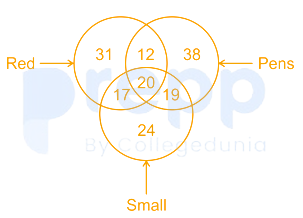
In the given figure, how many red are pens?
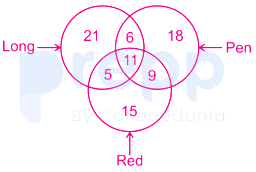
In the given figure, how many long pens are red?
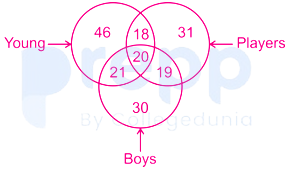
In the figure, how many players are young?
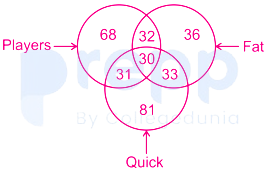
In the given figure, how many players are quick and fat?
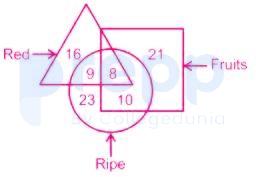
In the given figure, how many red fruits are ripe?
- An office has a total of 95 employees. Each employee participates in one or more of three activities, i.e. music, dance and skit, during the annual festival. The number of employees participating in only music is 20, whereas 14 participate in only skit, and 17 participate in only dance. A total of 8 employees participate in both music and skit only, 12 employees participate in all three activities, and 15 employees participate in both dance and skit only, whereas 9 employees participate in both music and dance only. Find the total number of employees participating in skit?
Study the given diagram carefully and answer the question. The numbers in different sections indicate the number of persons.
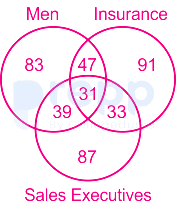
How many man are sales executives in the insurance industry?
- Observe the given Venn diagram and answer the following question.
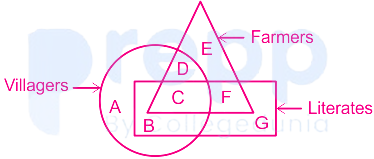
Which section stands for illiterate villagers who are farmers?
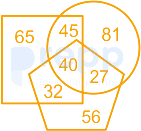
In the following Venn diagram, the pentagon stands for 'girls’, the square stands for ‘mobile phone users’, and the circle stands for ‘toppers’, The given numbers represent the number of persons in that particular category. How many girls are toppers but do NOT use mobile phones?
In a class of 45 students, all students participate in one or both of the two games, i.e. Chess and Badminton on. 11 students participate in both the games, whereas 17 students participate only in Chess. How many total students participate in Badminton?
Important Questions from Venn Diagram Problems
In a group of 73 friends, 14 friends go to Gym and Karate classes both, whereas 7 friends neither go to Gym class nor to Karate class. If a total of 36 friends go to Gym class, then how many friends go to only Karate class?
In an examination 20% students failed in Mathematics and 15% failed in English. If 10% failed in both and those who passed in both numbered 300, then the total number of students who appeared in the examination was
In the following diagram, the 'circle' stands for 'soldiers', the 'square' stands for 'Indians', and the 'triangle' stands for 'singers'. The numbers given in the different segments represent persons belonging to that category.
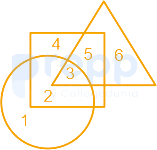
Which category is represented by the number '5'?
- In the following diagram, the circle stands for 'policemen', the square stands for 'sportspersons' and the 'triangle' stands for 'tax-payers' the numbers given in the different segments represent the number of persons in that category.
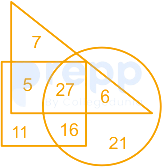
How many policemen are tax-payers but are NOT sportspersons?
The letter that represents the artists who are the doctors and dancers only is



