
In a certain code language, 'FLBS' is coded as '156' and 'MXT' is coded as '228'. How will 'VDZN' be coded in the same language?
264
To solve the problem of coding transformation, we need to decode the pattern or rule applied to convert letters into numbers.
Let’s analyze the given examples:
- 'FLBS' is coded as '156'
- 'MXT' is coded as '228'
We will determine the numerical equivalent of each letter using their positions in the alphabet. The alphabet positions are as follows:
- F = 6, L = 12, B = 2, S = 19
- M = 13, X = 24, T = 20
Next, let us sum these values for each word:
- 'FLBS': 6 + 12 + 2 + 19 = 39
- 'MXT': 13 + 24 + 20 = 57
Now, observe a pattern: Each word's code is the sum of alphabet positions multiplied by a factor:
- For 'FLBS': 39 \times 4 = 156
- For 'MXT': 57 \times 4 = 228
This suggests the coding rule: sum the alphabet positions and multiply by 4.
Let’s apply this rule to 'VDZN':
- V = 22, D = 4, Z = 26, N = 14
- Sum: 22 + 4 + 26 + 14 = 66
Now, we multiply the sum by 4:
- 66 \times 4 = 264
Thus, the code for 'VDZN' following the pattern is 264, which matches with one of the given options.
Conclusion: The correct code for 'VDZN' is 264.
Similar Questions
- If HOUSE is written as FQSUC , then how can CHAIR be written in that code?
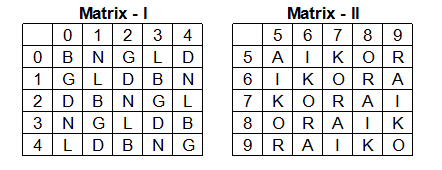
In the question, a word is represented by only one set of numbers as given in any one of the alternatives. The sets of numbers given in the alternatives are represented by two classes of alphabets as in two matrices given below. The columns and rows of Matrix I are numbered from 0 to 4 and that of Matrix II are numbered from 5 to 9. A letter from these matrices can be represented first by its row and next by its column, e.g., ‘B’ can be represented by 00, 13 etc., and ‘A’ can be represented by 55, 69 etc.
Similarly you have to identify the set for the word ‘GIRL’
A word is represented by only one set of numbers as given in any one of the alternatives. The sets of numbers given in the alternatives are represented by two classes of alphabets as in two matrices given below. Find the set for the word 'FINE'.
MATRIX I
0 1 2 3 4 F A N O I I O F A N A N O I F O F I N A N I A F O MATRIX II
5 6 7 8 9 S E H B T H S E T B B T S E H E H T B S T S E H B Gopal is older than Mohan but younger than Ram. Mohan is older than Sohan but younger than Ram. Who is the oldest?
From the given alternative words, select the word which cannot be formed using the letters of the given word:
ENDEAVOURIn a certain code, GIVE is written as VIEG and OVER is written as EVRO. How will DISK be written in that code?
If A denotes '+', B denotes '-', C denotes 'x', and D denotes '÷', then which of the following statement is true?
If A=1, HAT=29, then PAN=?
If S = 19, SUN = 54 and CAKE = 20, then MISTAKE = ?
A,B,C,D,E,F are sitting on the round table with equal distances. F is sitting opposite to E and between A and D. C is sitting right side of E and opposite to A. Who are the neighbours of A?
Important Questions from Coding decoding
The letters from A to Z are numbered from 1 to 26 respectively. If GHI = 1578 and DEF = 912, then what is ABC equal to?
What is the missing term in the following? ACPQ : BESU:: MNGI: @
what is the largest number among the following?
What is the greatest length x such that 3 ½ m and 8 ¾ m are integral multiples of x?
In a certain code, '256' means 'red colour chalk', '589' means 'green colour flower' and '254' means 'white colour chalk'. The digit in the code that indicates `white' is



