Understanding Fundamental Charges
In physics, electric charge is a fundamental property of matter. The smallest unit of observable electric charge is called the elementary charge, denoted by the symbol e. Protons carry a positive charge equal to +e, while electrons carry a negative charge equal to -e. All observable charges are known to be integral multiples of this elementary charge, a concept known as charge quantization.
Calculating Charge from Electrons
An object containing x electrons will have a total charge contributed by these electrons. Since each electron carries a charge of -e, the total charge from x electrons is:
Charge from electrons = $x \times (-e) = -xe$
Calculating Charge from Protons
Similarly, an object containing y protons will have a total charge contributed by these protons. Since each proton carries a charge of +e, the total charge from y protons is:
Charge from protons = $y \times (+e) = +ye$
Determining the Net Charge
The net charge on an object is the algebraic sum of the charges of all the charged particles it contains. In this case, the object has x electrons and y protons. Therefore, the net charge is the sum of the charge from electrons and the charge from protons:
Net Charge = (Charge from electrons) + (Charge from protons)
Net Charge = $(-xe) + (+ye)$
Net Charge = $ye - xe$
Factoring out e, we get:
Net Charge = $(y - x)e$
Conclusion
Based on the calculation, the net charge on an object containing x electrons and y protons is (y - x)e.
Important Questions from Electric Charges and Fields
Two charged particles, placed at a distance d apart in vacuum, exert a force F on each other. Now, each of the charges is doubled. To keep the force unchanged, the distance between the charges should be changed to:
When a slab of insulating material 4 mm thick is introduced between the plates of a parallel plate capacitor of separation 4 mm, it is found that the distance between the plates has to be increased by 3.2 mm to restore the capacity to its original value. The dielectric constant of the material is:
Match List - I with List - II.
List - I List - II (A) Electric Field (I) [LTA] (B) Electric Flux (II) [L2] (C) Electric Dipole Moment (III) [ML3T−3A−1] (D) Area Vector Element (IV) [MLT−3A−1] Choose the correct answer from the options given below:
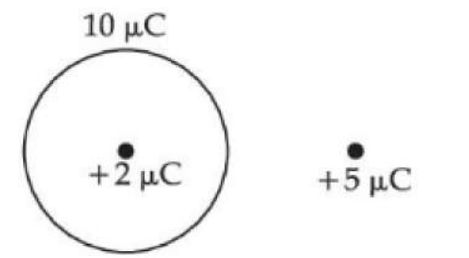
A thin metallic spherical shell contains a charge +10 μC on it. A point charge +2 μC is placed at the centre of the shell and another charge +5 μC is placed outside it as shown. The force on the charge +2 μC at the centre is:
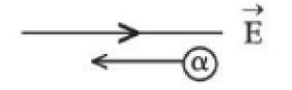
In the figure, an α-particle moves a distance l in a uniform electric field E as shown. Does the Electric Field do a positive or a negative work on the α-particle? Does the electric potential energy of the α-particle increase or decrease?