
Fastest Power Electronic Switching Device
The fastest switching device among SCR, GTO, IGBT, and Power MOSFET, assuming similar power ratings, is the Power MOSFET.
Device Switching Speed Comparison
Switching speed refers to how quickly a device can turn on and turn off. This is critical in power electronics for efficiency and performance. Here's a comparison:
- SCR (Silicon Controlled Rectifier): Generally the slowest. It requires the anode current to drop below the holding current or a reverse voltage to turn off. Turn-off is not controlled by the gate.
- GTO (Gate Turn-Off Thyristor): Faster than SCRs. It offers controlled turn-off using a negative gate pulse. However, it still involves minority carrier effects, limiting its speed compared to transistors.
- IGBT (Insulated Gate Bipolar Transistor): A hybrid device combining MOSFET input characteristics with bipolar output characteristics. It's faster than GTOs and SCRs but slower than MOSFETs due to the bipolar component's charge storage effects.
- Power MOSFET: The fastest among the options. Being a majority carrier device, it does not suffer from minority carrier storage time delays during turn-off. Its switching speed is primarily limited by the time taken to charge and discharge the gate capacitance and internal parasitic capacitances.
Reasoning for MOSFET Speed
Power MOSFETs utilize majority carriers (electrons or holes) for conduction. Unlike devices relying on minority carriers (like BJTs, or the bipolar part of IGBTs, and thyristors), there is no "minority carrier storage time" delaying the turn-off process. This intrinsic characteristic makes them significantly faster, enabling operation at higher switching frequencies.
Important Questions from Power Semiconductor Diodes and Transistors
Which semiconductor power device, out of the following, is not a current triggered device?
Diacs are primarily used as:
Which of the following circuit is used to obtain pulse gate triggering?
The figure shows a straight-line approximation for the forward characteristics of a power diode. A continuous on-state current of 15 A is flowing through the diode.
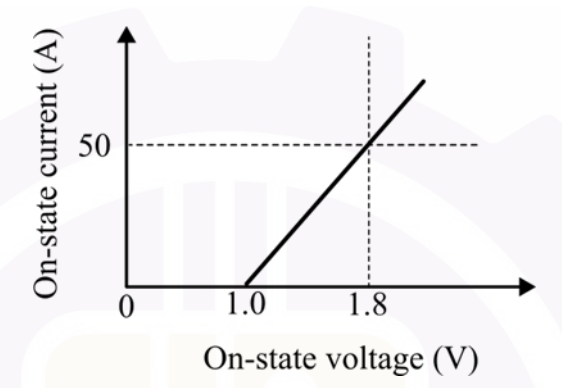
What is the power loss in the diode?
For a system with $G(S)=\frac{k}{S(S+1)(S+2)}$, $H(S)=1$. Determine the brake away point.


