
Probability of Drawing Same Letter
We need to find the probability that a letter drawn randomly from the word CAUSE is the same as a letter drawn randomly from the word EFFECT.
Letters in Each Word
Word 1: CAUSE
- Number of letters = 5
- Letters present: C, A, U, S, E (each appearing once)
Word 2: EFFECT
- Number of letters = 6
- Letters present: E (twice), F (twice), C (once), T (once)
Calculating Total Possible Outcomes
The total number of ways to draw one letter from CAUSE and one letter from EFFECT is the product of the number of letters in each word.
Total Outcomes = (Number of letters in CAUSE) $\times$ (Number of letters in EFFECT)
Total Outcomes = $5 \times 6 = 30$
Calculating Favorable Outcomes (Same Letter)
We need to find the pairs of letters that are the same from both words.
- Common Letters: The letters that appear in both words are 'C' and 'E'.
- Case 1: Drawing 'C'
- Ways to draw 'C' from CAUSE = 1
- Ways to draw 'C' from EFFECT = 1
- Number of pairs with 'C' = $1 \times 1 = 1$
- Case 2: Drawing 'E'
- Ways to draw 'E' from CAUSE = 1
- Ways to draw 'E' from EFFECT = 2
- Number of pairs with 'E' = $1 \times 2 = 2$
Total Favorable Outcomes = (Pairs with 'C') + (Pairs with 'E')
Total Favorable Outcomes = $1 + 2 = 3$
Determining the Probability
The probability is the ratio of favorable outcomes to total possible outcomes.
Probability = $\frac{\text{Total Favorable Outcomes}}{\text{Total Outcomes}}$
Probability = $\frac{3}{30} = \frac{1}{10}$
Important Questions from Probability (Notes)
- A stick of length L is broken into two pieces at random. What is the average length of the smaller piece?
- Two students are solving the same problem independently. If the probability that the first one solves the problem is $\frac{3}{5}$ and the probability that the second solves the problem is $\frac{4}{5}$, what is the probability that at least one of them solves the problem?
- A fair die was thrown three times and the outcome was repeatedly six. If the die is thrown again what is the probability of getting six?
A canal system is shown in the figure.
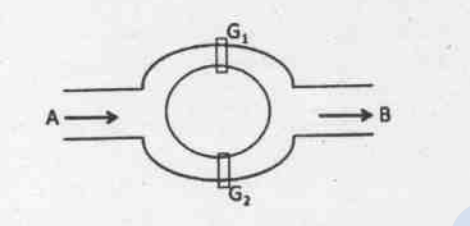
Water flows from A to B through two channels. Gates $G_1$ and $G_2$ are operated independently to regulate the flow. Probability of $G_1$ to be open is 10% while that of $G_2$ is 20%. The probability that water will flow from A to B is
- A standard fair die is rolled until some face other than 5 or 6 turns up. Let $X$ denote the face value of the last roll, and $A = \{X \text{ is even}\}$ and $B = \{X \text{ is at most 2}\}$. Then,


