
Probability Data Analysis
We are given the following probabilities:
- Probability of passing Mathematics, $P(\text{Math}) = 40\% = 0.40$
- Probability of passing Physics, $P(\text{Physics}) = 20\% = 0.20$
- Probability of passing both Mathematics and Physics, $P(\text{Math} \cap \text{Physics}) = 10\% = 0.10$
Calculating Conditional Probability
The question asks for the probability that a student passed in Physics given that they have already passed in Mathematics. This is a conditional probability problem.
The formula for conditional probability is:
$ P(A|B) = \frac{P(A \cap B)}{P(B)} $In this case, let:
- Event A = Student passed in Physics
- Event B = Student passed in Mathematics
We want to find $P(\text{Physics}|\text{Math})$.
Applying the Formula
Using the formula with the given values:
$ P(\text{Physics}|\text{Math}) = \frac{P(\text{Physics} \cap \text{Math})}{P(\text{Math})} $Substitute the known probabilities:
$ P(\text{Physics}|\text{Math}) = \frac{0.10}{0.40} $Simplify the fraction:
$ P(\text{Physics}|\text{Math}) = \frac{10}{40} = \frac{1}{4} $Thus, the probability of a randomly selected student having passed in Physics, given they passed in Mathematics, is $1/4$.
Important Questions from Probability (Notes)
- A stick of length L is broken into two pieces at random. What is the average length of the smaller piece?
- Two students are solving the same problem independently. If the probability that the first one solves the problem is $\frac{3}{5}$ and the probability that the second solves the problem is $\frac{4}{5}$, what is the probability that at least one of them solves the problem?
- A fair die was thrown three times and the outcome was repeatedly six. If the die is thrown again what is the probability of getting six?
- 12 balls, 3 each of the colours red, green, blue and yellow are put in a box and mixed. If 3 balls are picked at random, without replacement, the probability that all 3 balls are of the same colour is
A canal system is shown in the figure.
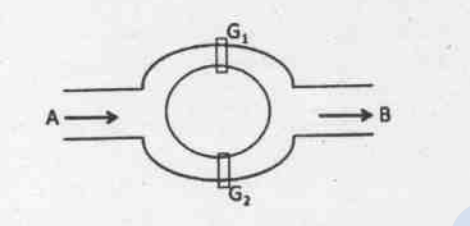
Water flows from A to B through two channels. Gates $G_1$ and $G_2$ are operated independently to regulate the flow. Probability of $G_1$ to be open is 10% while that of $G_2$ is 20%. The probability that water will flow from A to B is


