
Probability Calculation Steps
Let $S_1$ be the event that the first student solves the problem, and $S_2$ be the event that the second student solves the problem.
We are given the probabilities:
- Probability of the first student solving: $P(S_1) = \frac{3}{5}$
- Probability of the second student solving: $P(S_2) = \frac{4}{5}$
We need to find the probability that at least one student solves the problem. This is represented as $P(S_1 \cup S_2)$.
It's often easier to calculate the probability of the complementary event: that *neither* student solves the problem. Let $\overline{S_1}$ be the event that the first student does not solve, and $\overline{S_2}$ be the event that the second student does not solve.
Calculating Complement Probabilities
The probabilities of the students *not* solving the problem are:
- $P(\overline{S_1}) = 1 - P(S_1) = 1 - \frac{3}{5} = \frac{5}{5} - \frac{3}{5} = \frac{2}{5}$
- $P(\overline{S_2}) = 1 - P(S_2) = 1 - \frac{4}{5} = \frac{5}{5} - \frac{4}{5} = \frac{1}{5}$
Probability of Neither Solving
Since the students solve the problem independently, the probability that neither solves it is the product of their individual probabilities of not solving:
$P(\overline{S_1} \cap \overline{S_2}) = P(\overline{S_1}) \times P(\overline{S_2})$
$P(\overline{S_1} \cap \overline{S_2}) = \frac{2}{5} \times \frac{1}{5} = \frac{2}{25}$
Final Probability Calculation
The probability that at least one student solves the problem is 1 minus the probability that neither solves it:
$P(\text{at least one solves}) = 1 - P(\text{neither solves})$
$P(S_1 \cup S_2) = 1 - P(\overline{S_1} \cap \overline{S_2})$
$P(S_1 \cup S_2) = 1 - \frac{2}{25} = \frac{25}{25} - \frac{2}{25} = \frac{23}{25}$
Important Questions from Probability (Notes)
- A stick of length L is broken into two pieces at random. What is the average length of the smaller piece?
- A fair die was thrown three times and the outcome was repeatedly six. If the die is thrown again what is the probability of getting six?
A canal system is shown in the figure.
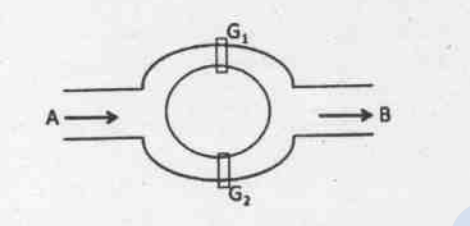
Water flows from A to B through two channels. Gates $G_1$ and $G_2$ are operated independently to regulate the flow. Probability of $G_1$ to be open is 10% while that of $G_2$ is 20%. The probability that water will flow from A to B is
- A standard fair die is rolled until some face other than 5 or 6 turns up. Let $X$ denote the face value of the last roll, and $A = \{X \text{ is even}\}$ and $B = \{X \text{ is at most 2}\}$. Then,
- Let $X$ and $Y$ be i.i.d. uniform $(0,1)$ random variables. Let $Z = \max(X,Y)$ and $W = \min(X,Y)$.
Then $P((Z-W) > 1/2)$ is


