
Probability of Six on Next Throw
The core principle to understand here is the concept of independent events in probability.
- A fair die has 6 faces, numbered 1 through 6.
- Each face has an equal probability of landing face up on any given throw.
- Crucially, each throw of the die is an independent event. This means the outcome of previous throws has absolutely no influence on the outcome of the next throw.
The fact that the die landed on six three times in a row does not change the inherent probabilities for the *next* throw.
Calculating Single Event Probability
For a fair die, the probability of rolling any specific number (like a six) is calculated as:
$P(\text{Specific Outcome}) = \frac{\text{Number of favorable outcomes}}{\text{Total number of outcomes}}$In this case, for rolling a six:
$P(\text{rolling a 6}) = \frac{1}{6}$Conclusion for Next Throw
Since the next throw is independent of the previous ones, the probability of getting a six remains the same as it was for the first throw.
Therefore, the probability of getting a six on the next throw is $1/6$.
Important Questions from Probability (Notes)
- A stick of length L is broken into two pieces at random. What is the average length of the smaller piece?
- Two students are solving the same problem independently. If the probability that the first one solves the problem is $\frac{3}{5}$ and the probability that the second solves the problem is $\frac{4}{5}$, what is the probability that at least one of them solves the problem?
A canal system is shown in the figure.
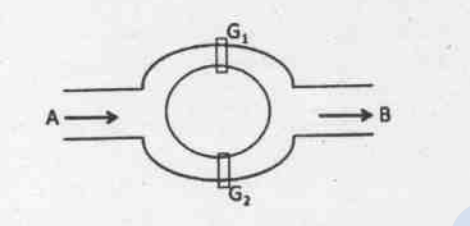
Water flows from A to B through two channels. Gates $G_1$ and $G_2$ are operated independently to regulate the flow. Probability of $G_1$ to be open is 10% while that of $G_2$ is 20%. The probability that water will flow from A to B is
- A standard fair die is rolled until some face other than 5 or 6 turns up. Let $X$ denote the face value of the last roll, and $A = \{X \text{ is even}\}$ and $B = \{X \text{ is at most 2}\}$. Then,
- Let $X$ and $Y$ be i.i.d. uniform $(0,1)$ random variables. Let $Z = \max(X,Y)$ and $W = \min(X,Y)$.
Then $P((Z-W) > 1/2)$ is


