
Probability Calculation for Same Colored Balls
The problem asks for the probability of picking 3 balls of the same colour from a box containing 12 balls.
- Total balls = 12
- Number of colours = 4 (Red, Green, Blue, Yellow)
- Number of balls of each colour = 3
- Number of balls picked = 3 (without replacement)
Total Possible Outcomes
The total number of ways to pick any 3 balls from the 12 available balls is calculated using combinations:
Total Combinations = $ \binom{12}{3} $
$ \binom{12}{3} = \frac{12!}{3!(12-3)!} = \frac{12 \times 11 \times 10}{3 \times 2 \times 1} = 2 \times 11 \times 10 = 220 $
So, there are 220 possible ways to pick 3 balls from the box.
Favorable Outcomes (All Same Colour)
For all 3 balls to be the same colour, we must pick 3 balls of a single colour. There are 4 colours to choose from.
For any specific colour (e.g., Red), there are 3 balls. The number of ways to pick 3 balls of that specific colour is:
Ways for one colour = $ \binom{3}{3} $
$ \binom{3}{3} = \frac{3!}{3!(3-3)!} = \frac{3!}{3!0!} = 1 $
Since there are 4 colours, the total number of ways to pick 3 balls of the same colour is:
Favourable Combinations = (Number of colours) $ \times $ (Ways to pick 3 of one colour)
Favourable Combinations = $ 4 \times \binom{3}{3} = 4 \times 1 = 4 $
Calculating the Probability
The probability is the ratio of favourable outcomes to the total possible outcomes:
Probability (All 3 same colour) = $ \frac{\text{Favourable Combinations}}{\text{Total Combinations}} $
$ P(\text{All 3 same colour}) = \frac{4}{220} $
Simplifying the fraction:
$ P(\text{All 3 same colour}) = \frac{1}{55} $
Important Questions from Probability (Notes)
- In a class, 40% and 20% students passed in Mathematics and Physics, respectively, and 10% students passed in both subjects. What is the probability of a randomly selected student to have passed in Physics if the student already passed in Mathematics?
- A stick of length L is broken into two pieces at random. What is the average length of the smaller piece?
- Two students are solving the same problem independently. If the probability that the first one solves the problem is $\frac{3}{5}$ and the probability that the second solves the problem is $\frac{4}{5}$, what is the probability that at least one of them solves the problem?
- A fair die was thrown three times and the outcome was repeatedly six. If the die is thrown again what is the probability of getting six?
A canal system is shown in the figure.
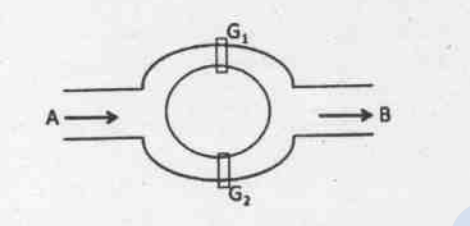
Water flows from A to B through two channels. Gates $G_1$ and $G_2$ are operated independently to regulate the flow. Probability of $G_1$ to be open is 10% while that of $G_2$ is 20%. The probability that water will flow from A to B is


