
If $'\div'$ stands for 'addition', '+' stands for 'subtraction', '×' stands for 'division' and '-' stands for 'multiplication', then which of the following equations will NOT be correct?
Symbol Substitution and Equation Verification
This problem requires substituting given symbols with arithmetic operations and then verifying the correctness of different equations using the order of operations (PEMDAS/BODMAS).
Symbol Mapping
The provided symbol substitutions are:
- The symbol '$÷$' stands for addition ($+$).
- The symbol '$+$' stands for subtraction ($-$).
- The symbol '$×$' stands for division ($÷$).
- The symbol '$-$' stands for multiplication ($×$).
Evaluating Each Option
Option 1: $36 ÷ 4 - 3 × 6 + 16 = 22$
After substituting the symbols, the expression becomes:
$36 + 4 \times 3 \div 6 - 16$
Evaluating using the order of operations:
1. Multiplication: $4 \times 3 = 12$. Expression: $36 + 12 \div 6 - 16$.
2. Division: $12 \div 6 = 2$. Expression: $36 + 2 - 16$.
3. Addition: $36 + 2 = 38$. Expression: $38 - 16$.
4. Subtraction: $38 - 16 = 22$.
Result: $22 = 22$. This equation is correct.
Option 2: $36 - 4 × 3 + 6 ÷ 16 = 60$
After substituting the symbols, the expression becomes:
$36 \times 4 \div 3 + 6 + 16$
Evaluating using the order of operations:
1. Multiplication: $36 \times 4 = 144$. Expression: $144 \div 3 + 6 + 16$.
2. Division: $144 \div 3 = 48$. Expression: $48 + 6 + 16$.
3. Addition: $48 + 6 = 54$. Expression: $54 + 16$.
4. Addition: $54 + 16 = 70$.
Result: $70 \neq 60$. This equation is NOT correct.
Option 3: $36 × 4 + 3 - 6 ÷ 16 = 7$
After substituting the symbols, the expression becomes:
$36 \div 4 - 3 \times 6 + 16$
Evaluating using the order of operations:
1. Division: $36 \div 4 = 9$. Expression: $9 - 3 \times 6 + 16$.
2. Multiplication: $3 \times 6 = 18$. Expression: $9 - 18 + 16$.
3. Subtraction: $9 - 18 = -9$. Expression: $-9 + 16$.
4. Addition: $-9 + 16 = 7$.
Result: $7 = 7$. This equation is correct.
Option 4: $36 + 4 ÷ 3 × 6 - 16 = 40$
After substituting the symbols, the expression becomes:
$36 - 4 + 3 \div 6 \times 16$
Evaluating using the order of operations:
1. Division: $3 \div 6 = 0.5$. Expression: $36 - 4 + 0.5 \times 16$.
2. Multiplication: $0.5 \times 16 = 8$. Expression: $36 - 4 + 8$.
3. Subtraction: $36 - 4 = 32$. Expression: $32 + 8$.
4. Addition: $32 + 8 = 40$.
Result: $40 = 40$. This equation is correct.
Conclusion
The analysis shows that the equation in Option 2 yields a result of $70$, which contradicts the given value of $60$. Therefore, Option 2 is the equation that will NOT be correct.
Similar Questions
- What will come in the place of the question mark (?) in the following equation, if '+' and '−' are interchanged and '×' and '÷' are interchanged?
65 × 5 − 19 ÷ 3 + 25 = ? - What will come in place of the question mark (?) in the following equation if '×' and '+' are interchanged and '−' and '÷' are interchanged?
32 ÷ 2 × 72 − 9 + 5 = ? - If '+' means '$\div$', '$-$' means '$\times$', '$\div$' means '+' and '$\times$' means '$-$', then find the value of $2 - 1 \times 4 \div 4 + 2$?
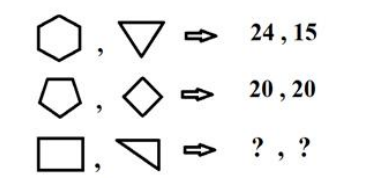
Study the given pattern carefully and select the numbers from among the options that can replace the question marks (?).
- If $\nabla$ stands for operation "adding the first number to thrice the second number", then the value of $(4 \nabla 5) \nabla 6$ will be:
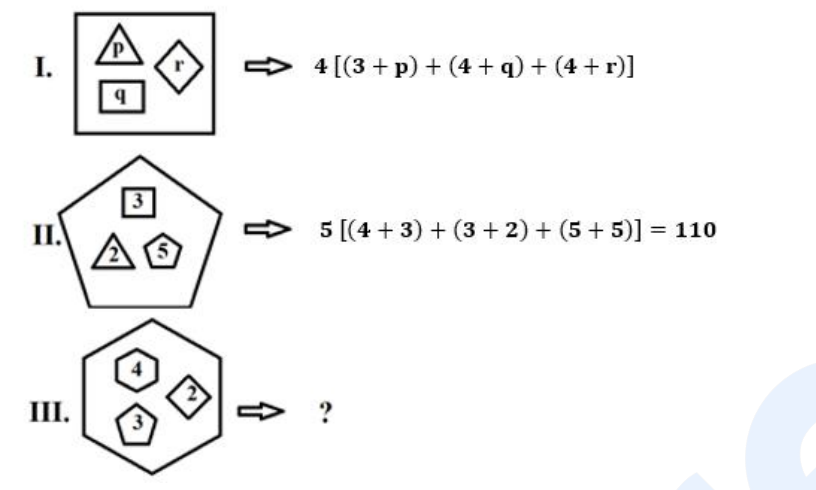
Study the given pattern carefully and select the number from among the given option that can replace the question mark (?).
- If '+' means 'division', '-' means 'addition', '$\times$' means 'subtraction' and '$\div$' means 'multiplication', then what will be the value of the following expression?
$\frac{[ \{ (20 \times 18) - (9 \div 3) \} + (5 - 2) ]}{1}$ - What will come in the place of the question mark (?) in the following equation, if ‘+’ and ‘−’ are interchanged and ‘×’ and ‘÷’ are interchanged?
25 − 9 × 3 + 4 ÷ 2 = ? - What will come in place of the question mark (?) in the following equation, if ‘+’ and ‘−’ are interchanged and ‘×’ and ‘÷’ are interchanged?
12 ÷ 6 + 28 × 4 − 11 = ? - If '+' means 'subtraction', '$\div$' means 'addition', '$-$' means 'multiplication' and '$\times$' means 'division', then what is the value of $15 \div (5 + 8)$?
Important Questions from Mathematical Operations
Select the set, from the given options, in which the numbers are related in the same way as are the numbers of the following sets.
(NOTE: Operations should be performed on the whole numbers, without breaking down the numbers into its constituent digits. E.g. 13 – Operations on 13 such as adding/subtracting/multiplying etc. to 13 can be performed. Breaking down 13 into 1 and 3 and then performing mathematical operations on 1 and 3 is not allowed.)
(6, 13, 78)
(5, 22, 110)
If + means -, - means ×, × means ÷, ÷ means +, then what will come in place of the question mark (?) in the following equation?
28 - 6 ÷ 4 + 14 × 14 = ?
In the following number-pairs, the second number is obtained by applying certain mathematical operations to the first number. Which numbers should replace X and Y so that the pattern followed by the two numbers on the left side of :: is the same as that on the right side of :: ?
(NOTE: Operations should be performed on the whole numbers, without breaking down the numbers into its constituent digits. E.g. 13 Operations on 13 such as adding/subtracting /multiplying etc. to 13 can be performed. Breaking down 13 into 1 and 3 and then performing mathematical operations on 1 and 3 is not allowed.)
X : 649 :: 956 : Y
Which two numbers should be interchanged to make the given equation correct?
75 ÷ 5 + 15 × 4 - 17 × 3 + (60 ÷ 6) × 10 = 100
(Note: Interchange should be done of the entire number and not individual digits of a given number.)
If ‘A’ stands for ‘\(\div \)', ‘B’ stands for ‘x', ‘C’ stands for ‘+', ‘D’ stands for ‘-', what will come in the place of the question mark '?' in the following equation?
225 B 15 A 15 C 125 D 225 = ?



