57 $\square$ 3 $\square$ 2 $\square$ 2 $\square$ 15 $\square$ 25
Mathematical Symbols for Balanced Equation
The goal is to identify the sequence of mathematical symbols that makes the equation 57 $\square$ 3 $\square$ 2 $\square$ 2 $\square$ 15 $\square$ 25 a true statement.
Evaluating Symbol Combinations
We test the options by substituting the symbol sequence and evaluating the resulting expression using the standard order of operations (PEMDAS/BODMAS).
Analyzing Option B: $\div$, $\times$, $+$, $=$, $+$
Let's substitute the symbols from Option B:
$57 ÷ 3 × 2 + 2 = 15 + 25$
Applying the order of operations:
- First, perform division: $57 ÷ 3 = 19$. The equation becomes $19 × 2 + 2 = 15 + 25$.
- Next, perform multiplication: $19 × 2 = 38$. The equation becomes $38 + 2 = 15 + 25$.
- Now, perform addition on the left side: $38 + 2 = 40$. The equation becomes $40 = 15 + 25$.
- Perform addition on the right side: $15 + 25 = 40$.
- Finally, compare the results: $40 = 40$.
Since $40 = 40$ is a true statement, Option B provides the correct combination of symbols to balance the equation.
Result
The sequence $\div$, $\times$, $+$, $=$, $+$ correctly balances the given mathematical expression.
Similar Questions
- What will come in the place of the question mark (?) in the following equation, if '+' and '−' are interchanged and '×' and '÷' are interchanged?
65 × 5 − 19 ÷ 3 + 25 = ? - What will come in place of the question mark (?) in the following equation if '×' and '+' are interchanged and '−' and '÷' are interchanged?
32 ÷ 2 × 72 − 9 + 5 = ? - If '+' means '$\div$', '$-$' means '$\times$', '$\div$' means '+' and '$\times$' means '$-$', then find the value of $2 - 1 \times 4 \div 4 + 2$?
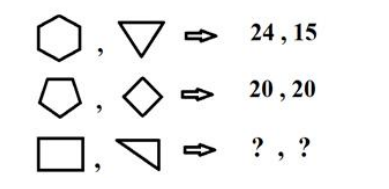
Study the given pattern carefully and select the numbers from among the options that can replace the question marks (?).
- If $\nabla$ stands for operation "adding the first number to thrice the second number", then the value of $(4 \nabla 5) \nabla 6$ will be:
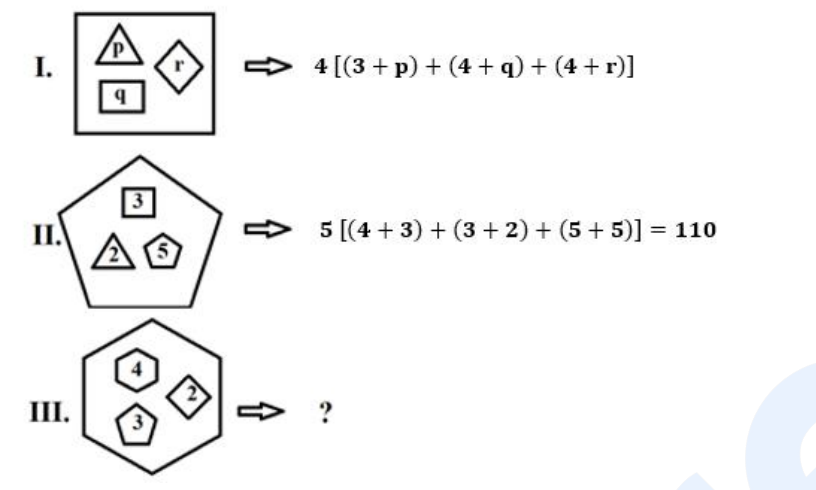
Study the given pattern carefully and select the number from among the given option that can replace the question mark (?).
- If '+' means 'division', '-' means 'addition', '$\times$' means 'subtraction' and '$\div$' means 'multiplication', then what will be the value of the following expression?
$\frac{[ \{ (20 \times 18) - (9 \div 3) \} + (5 - 2) ]}{1}$ - If '+' means 'subtraction', '$\div$' means 'addition', '$-$' means 'multiplication' and '$\times$' means 'division', then what is the value of $15 \div (5 + 8)$?
If '$+$' means 'subtraction', '$\div$' means 'addition', '$-$' means 'multiplication' and '$\times$' means 'division', then what is the value of $(8 + 2 - 19) - (4 + 27 \times 3)$?
- In a farmer's house, there are Chickens and goats. The total number of their heads is 42 and the total number of their legs is 138. Find the number of Chickens.
Important Questions from Mathematical Operations
Select the set, from the given options, in which the numbers are related in the same way as are the numbers of the following sets.
(NOTE: Operations should be performed on the whole numbers, without breaking down the numbers into its constituent digits. E.g. 13 – Operations on 13 such as adding/subtracting/multiplying etc. to 13 can be performed. Breaking down 13 into 1 and 3 and then performing mathematical operations on 1 and 3 is not allowed.)
(6, 13, 78)
(5, 22, 110)
If + means -, - means ×, × means ÷, ÷ means +, then what will come in place of the question mark (?) in the following equation?
28 - 6 ÷ 4 + 14 × 14 = ?
In the following number-pairs, the second number is obtained by applying certain mathematical operations to the first number. Which numbers should replace X and Y so that the pattern followed by the two numbers on the left side of :: is the same as that on the right side of :: ?
(NOTE: Operations should be performed on the whole numbers, without breaking down the numbers into its constituent digits. E.g. 13 Operations on 13 such as adding/subtracting /multiplying etc. to 13 can be performed. Breaking down 13 into 1 and 3 and then performing mathematical operations on 1 and 3 is not allowed.)
X : 649 :: 956 : Y
Which two numbers should be interchanged to make the given equation correct?
75 ÷ 5 + 15 × 4 - 17 × 3 + (60 ÷ 6) × 10 = 100
(Note: Interchange should be done of the entire number and not individual digits of a given number.)
If ‘A’ stands for ‘\(\div \)', ‘B’ stands for ‘x', ‘C’ stands for ‘+', ‘D’ stands for ‘-', what will come in the place of the question mark '?' in the following equation?
225 B 15 A 15 C 125 D 225 = ?