
Square Axes of Symmetry: Understanding the Concept
The question asks for the number of axes of symmetry in a square. An axis of symmetry is a line that divides a shape into two identical halves that are mirror images of each other. If you fold the shape along this line, the two halves match perfectly.
Defining a Square
A square is a special type of quadrilateral (a four-sided polygon) with the following properties:
- All four sides are equal in length.
- All four interior angles are right angles (equal to 90 degrees).
Identifying Axes of Symmetry in a Square
Let's identify all the lines that can divide a square into two mirror-image halves:
-
Line connecting midpoints of opposite sides:
- There is a line that passes through the midpoint of the top side and the midpoint of the bottom side. This line divides the square vertically into two identical rectangles.
- Similarly, there is a line that passes through the midpoint of the left side and the midpoint of the right side. This line divides the square horizontally into two identical rectangles.
-
Diagonals:
- A square has two diagonals, which connect opposite corners.
- Each diagonal divides the square into two identical right-angled triangles.
Counting the Axes
Adding the axes from both categories:
- Lines connecting midpoints: 2
- Diagonals: 2
- Total axes = 2 + 2 = 4
Conclusion
A square possesses exactly 4 axes of symmetry. These consist of the two lines joining the midpoints of opposite sides and the two diagonals.
Important Questions from Geometry (Notes)
- A 6 cm long chord of a circle is at a distance of 4 cm from the centre of the circle. Find the distance of 8 cm long chord of the same circle from the centre.
- In a triangle PQR, if $\angle P + \angle R = 150^\circ$ and $\angle P + 3\angle Q = 170^\circ$, then $\angle P$ is equal to :
- PQR is a triangle. The bisectors of the internal angle $\angle Q$ and external angle $\angle R$ intersect at M. If $\angle QMR = 40^\circ$, then $\angle P$ is :
- A $2\text{ m}$ long ladder is to reach a wall of height $1.75\text{ m}$. The largest possible horizontal distance of the ladder from the wall could be
Three-quarters of a circle is shown in the figure; OA and OB are two radii perpendicular to each other. C is a point on the circle.
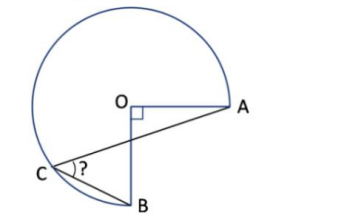
What is angle ACB?


