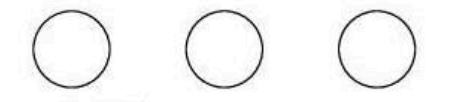
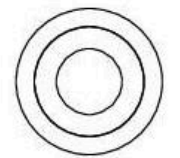
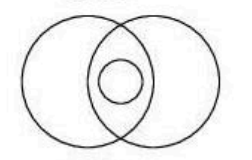
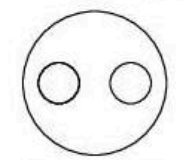
Given below are two statements : one is labelled as Assertion (A) and the other is labelled as Reason (R). Assertion (A) : All continents were united together in the past. Reason (R) : The Gangamopteris and Glossopteris flora have been found on all the southern continents. In the light of the above statements, choose the most appropriate answer from the options given below :
Assertion (A) Correctness
The statement asserts that all continents were united together in the past. This is consistent with the widely accepted scientific theory of continental drift, which posits the existence of a supercontinent named Pangaea that existed approximately 335 to 175 million years ago. Therefore, Assertion (A) is considered correct.
Reason (R) Correctness
The statement claims that Gangamopteris and Glossopteris flora have been found on all the southern continents. Fossil evidence, including these specific plant types (Glossopteris flora), has indeed been discovered across South America, Africa, India, Antarctica, and Australia. This distribution is a significant piece of evidence supporting the past connection of these landmasses.
Therefore, Reason (R) is also considered correct.
Explanation Analysis
While the discovery of Gangamopteris and Glossopteris flora (Reason R) across the southern continents provides strong evidence for the past existence of Gondwanaland (a major component of the supercontinent Pangaea), it does not solely or completely explain the union of *all* continents.
The union of *all* continents into Pangaea is supported by multiple lines of evidence, including the matching shapes of continental coastlines, similar fossil distributions beyond just the southern continents, matching geological structures, and paleomagnetic data. Reason (R) specifically relates to the southern landmasses forming Gondwanaland. It supports the idea of continental union but isn't the comprehensive explanation for the unification of the entire global landmass.
Consequently, although both statements are factually correct, the evidence presented in Reason (R) is not the definitive or complete explanation for Assertion (A).
Conclusion
Both Assertion (A) and Reason (R) are correct statements. However, Reason (R) provides evidence primarily for the existence of Gondwanaland, a part of the larger supercontinent, and thus is not the complete or direct explanation for why all continents were united together.
Similar Questions
Given below are two statements : one is labelled as Assertion (A) and the other is labelled as Reason (R).
Assertion (A) : Many natural disasters are caused by the volcanic activity occurring in the island arc systems.
Reason (R) : The fissure type volcanism causes the erupted lava to spread over wide areas.
In the light of the above statements, choose the most appropriate answer from the options given below :
Given below are two statements : one is labelled as Assertion (A) and the other is labelled as Reason (R).
Assertion (A) : Gypsum has lower density than anhydrite.
Reason (R) : Hydrated minerals tend to expand many times the original volume of the anhydrous minerals.
In the light of the above statements, choose the most appropriate answer from the options given below :
Given below are two statements : one is labelled as Assertion (A) and the other is labelled as Reason (R).
Assertion (A) : Drumlins show features opposite to those of Roches Moutonnees.
Reason (R) : The stoss side is steep and the lee side is roughened.
In the light of the above statements, choose the most appropriate answer from the options given below :
Given below are two statements : one is labelled as Assertion (A) and the other is labelled as Reason (R).
Assertion (A) : In a hand specimen quartz can be easily distinguished from orthoclase.
Reason (R) : Orthoclase has lower refractive index than quartz.
In the light of the above statements, choose the most appropriate answer from the options given below :
Given below are two statements : one is labelled as Assertion (A) and the other is labelled as Reason (R).
Assertion (A) : L waves are responsible for majority of the destructive earthquakes.
Reason (R) : They are the surface waves and develope in the immediate vicinity of the epicenter.
In the light of the above statements, choose the most appropriate answer from the options given below :
Given below are two statements : one is labelled as Assertion (A) and the other is labelled as Reason (R).
Assertion (A) : A dip-slip fault can be a wrench fault.
Reason (R) : Along a dip fault, the net slip can be equal to strike-slip, dip-slip or oblique-slip.
In the light of the above statements, choose the most appropriate answer from the options given below :
Given below are two statements : one is labelled as Assertion (A) and the other is labelled as Reason (R).
Assertion (A) : Chronostratigraphy is concerned with the mutual time relationship of strata.
Reason (R) : Formation, member and bed are units of chronostratigraphy.
In the light of the above statements, choose the most appropriate answer from the options given below :
Given below are two statements : one is labelled as Assertion (A) and the other is labelled as Reason (R).
Assertion (A) : The angle between any two faces of a crystal is termed as interfacial angle.
Reason (R) : The interfacial angles of corresponding faces of different crystals are constant if they have same chemical composition and measurements are taken at same temperature.
In the light of the above statements, choose the most appropriate answer from the options given below :
Match List - I with List - II.
List - I
Crystal SystemList - II
CharacteristicsA. Monoclinic I. 4 triads B. Tetragonal II. 3 diads C. Orthorhombic III. 1 tetrad D. Cubic IV. 1 diad Choose the correct answer from the options given below :
Match List - I with List - II.
List - I
Twin typeList - II
MineralA. Geneculated twins I. Staurolite B. Cruviform twins II. Rutile C. Butterfly twins III. Gypsum D. Arrow head twins IV. Calcite Choose the correct answer from the options given below :
Important Questions from Mixed Topic (CUET PG)
- Kalpsutra, the illustrated canonical text is from:-
- The Harappan city almost exclusively devoted to craft production was-:
- Mohandas Karamchand Gandhi launched quit India movement after the failure of:-
- The "Objectives Resolution" was introduced in constituent assembly by:-
- Who among the following was not a member of the constituent assembly:-